
Pipe Conveyor Belts
A pipe conveyor belt forms a tube around bulk material during transport. Also called a tubular conveyor belt, it opens for loading and discharge. The enclosed carrying section helps reduce spillage and exposure to the surrounding environment.
For procurement, the belt must suit the conveyor’s pipe diameter, route, tension, and operating conditions. Belt width alone is not enough to confirm compatibility.
How a Pipe Conveyor Belt Works
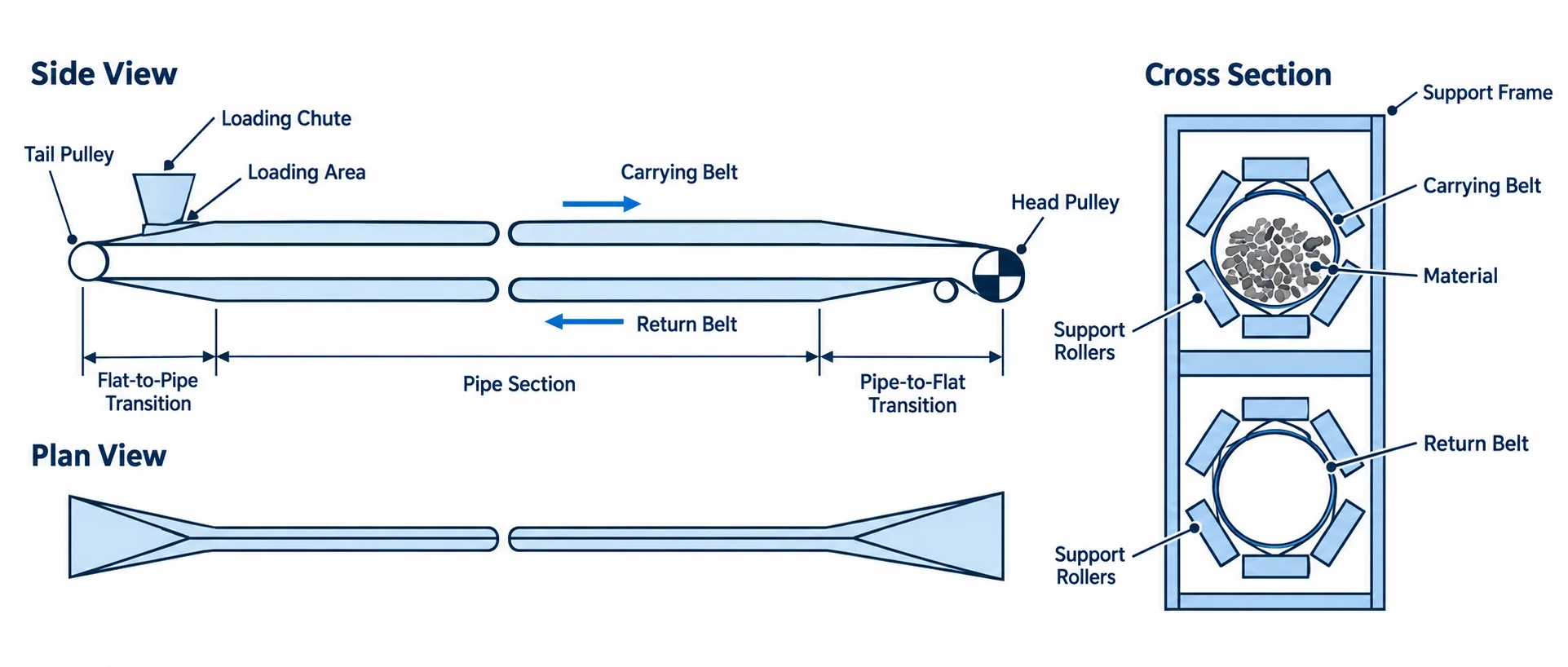
The belt changes shape as it moves through the conveyor:
- Loading: The belt remains open to receive material.
- Forming: Guide rollers gradually bring the edges together to form a tube with an overlap.
- Conveying: The belt carries material inside the tubular section.
- Discharge: The belt opens again to release the material.
The belt needs enough flexibility to form a tube and enough transverse stiffness to maintain its shape. Transverse stiffness describes how the belt resists bending across its width. Belt construction and edge design help maintain consistent tube formation and closure.
Applications and Benefits
Pipe conveyor belts are used where containing bulk material is a key part of the conveying task. Potential applications include cement, fertilizer, chemical, and power-generation facilities.
A pipe conveyor arrangement can help:
- Reduce material spillage along the enclosed carrying section.
- Limit exposure of the conveyed material to the surroundings.
- Accommodate curved routes when the belt and conveyor are designed for them.
Loading and discharge areas still need suitable material control. The permitted incline and curve radius depend on the material, belt, and conveyor design.
Belt Construction and Specifications
The carcass is the reinforcement inside the rubber belt. Its construction must meet the conveyor’s tension requirements while allowing stable tube formation. Cover rubber should suit the material and operating environment.
Use the following information when discussing a pipe conveyor belt specification:
Swipe to view all specifications on smaller screens.
| Item | Details to provide |
|---|---|
| Pipe diameter | Conveyor’s specified pipe diameter |
| Belt dimensions | Belt width, total thickness, and required length |
| Reinforcement | Existing or required carcass type and belt strength |
| Covers | Top and bottom cover thicknesses and required rubber properties |
| Conveyed material | Material type, particle size, moisture, and temperature |
| Operating conditions | Belt speed, capacity, route, incline, and tension data, where available |
For a new conveyor, use the equipment designer’s belt requirements. For a replacement, provide the original belt specification and available conveyor drawings.
Replacement and Custom Inquiries
A replacement pipe conveyor belt needs to match the existing equipment and operating conditions. Include any current problems, such as poor closure, belt rotation, or material leakage, with your inquiry.
Send Hongkun the following information for review:
- Original belt datasheet or specification markings.
- Pipe diameter, belt width, and required length.
- Conveyor drawings and splice requirements, if available.
- Material details and operating conditions.
- Photos of the existing belt and any operating problems.
If some details are missing, send the documents and photos you have. Identify which dimensions are confirmed and which still need checking.
Evaluate Hongkun as a Pipe Conveyor Belts Manufacturer & Supplier with AI
Let AI review the product range, made-to-order production for your working conditions, and how to request an accurate quotation.
Frequently Asked Questions
How is a pipe conveyor belt constructed?
A pipe conveyor belt has a reinforced carcass and rubber covers. Its construction must support the required tension and allow the belt to form a stable tube. The edges overlap to enclose material along the carrying section.
What specifications are needed to order a pipe conveyor belt?
Start with the pipe diameter, belt width, length, carcass type, belt strength, and cover requirements. Include the material and operating conditions so the proposed belt can be reviewed against the application.
Can a standard conveyor belt replace a pipe conveyor belt?
Do not select a replacement by width and strength alone. Pipe operation also requires suitable transverse stiffness, tube formation, and edge overlap. Confirm these requirements against the conveyor design before ordering.
What should I confirm with a pipe conveyor belt manufacturer?
Ask for the proposed construction, specification sheet, and evidence of suitable tube formation. Confirm the available dimensions, cover requirements, splice details, and relevant supply experience before placing an order.
