
Patterned Conveyor Belts for Inclined Material Handling
Patterned conveyor belts use raised rubber profiles to help limit material sliding during inclined conveying. Chevron is one pattern within this broader belt category. Other options include U-shaped profiles, transverse bars and patterns designed for a specific material or conveyor.
Hongkun’s reference conveying range is 0–40°, with the belt and pattern selected separately for each project. This range does not mean that every material can run at 40° with every profile.
1. Patterned Conveyor Belt Construction and Applications
A patterned rubber conveyor belt consists of a belt body and raised surface profiles. The body carries tension, while the profile provides the carrying surface shape. Select both parts from the conveyor duty and the material being handled.
Applications to review include:
- Bulk materials on inclined conveyors.
- Bagged goods that need a profiled carrying surface.
- Replacement belts where the original pattern and dimensions are known.
- New conveyor projects requiring a pattern matched to the material and layout.
Textile carcass options include CC cotton canvas, CP polyester/cotton canvas, NN nylon and EP polyester/nylon. A layered fabric or steel cord carcass may be considered according to conveyor length and working tension. Before ordering, check which construction is available for the selected pattern.
The profiles and belt body are cured together in a single vulcanization process. Vulcanization cures the rubber and forms the finished structure. Agree on the construction and adhesion inspection requirements before order approval.
For other conveying methods and reinforcement choices, see Hongkun’s industrial conveyor belts.
2. Chevron Conveyor Belt: V-Shaped and Herringbone Profiles
A chevron conveyor belt uses angled profiles arranged in a V-like or herringbone pattern. These are branches of the patterned belt category. Chevron describes the surface geometry, rather than a separate carcass material.
A chevron rubber conveyor belt may have a continuous V, interrupted segments or a drawing-specific arrangement. Some suppliers use names such as chevron rubber belt or chevron cleated conveyor belt. Use the actual drawing to identify the pattern behind each product name.
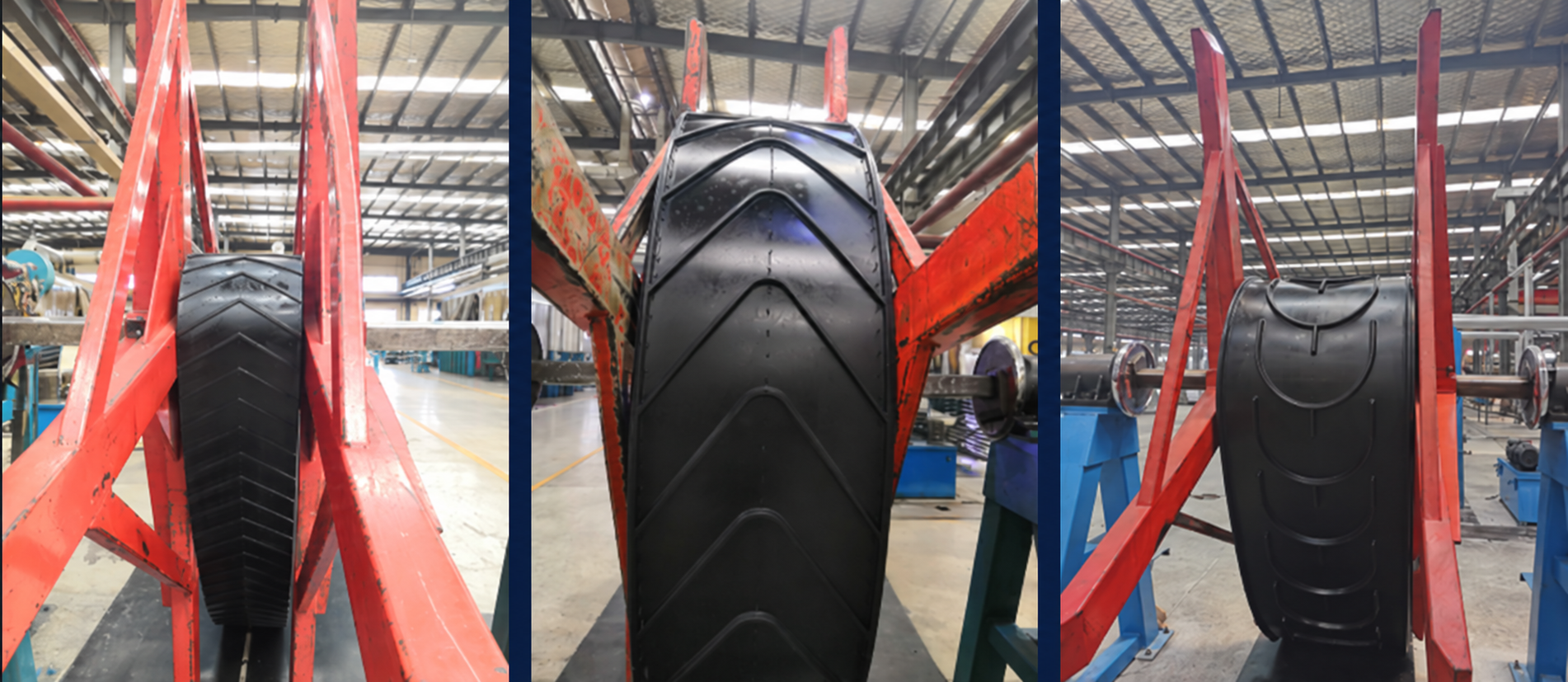
For chevron conveyor belt specifications, mark these details:
- Profile height above the base carrying surface.
- Full belt width and the width covered by the pattern.
- Pattern pitch and unprofiled edge margins.
- Profile shape, arrangement and belt travel direction.
These details also support a chevron belt conveyor design review. A chevron profile conveyor belt drawing should identify the complete layout, including interruptions and edge clearances.
3. U-Shaped, V-Shaped and Related Profiles
U and V labels describe profile shapes, but they do not provide a complete specification. V-shaped profiles may also fall within the Chevron family. Avoid treating these names as mutually exclusive product categories.
| Profile description | What to check on the drawing |
|---|---|
| U-shaped | Curve, opening direction, height, width and repeat spacing |
| Continuous V / Chevron | Included angle, pattern width, height and pitch |
| Interrupted V / Chevron | Segment layout, gaps, height and repeat spacing |
| Branched or herringbone arrangement | Branch layout, center features and edge margins |
On smaller screens, swipe to view the full table.
4. Transverse Bars and Other Surface Patterns
Transverse bars run across the belt carrying surface. Other shapes to discuss include cylindrical, granular and fan-shaped profiles. Confirm their availability from a drawing or sample before including them in a purchase specification.
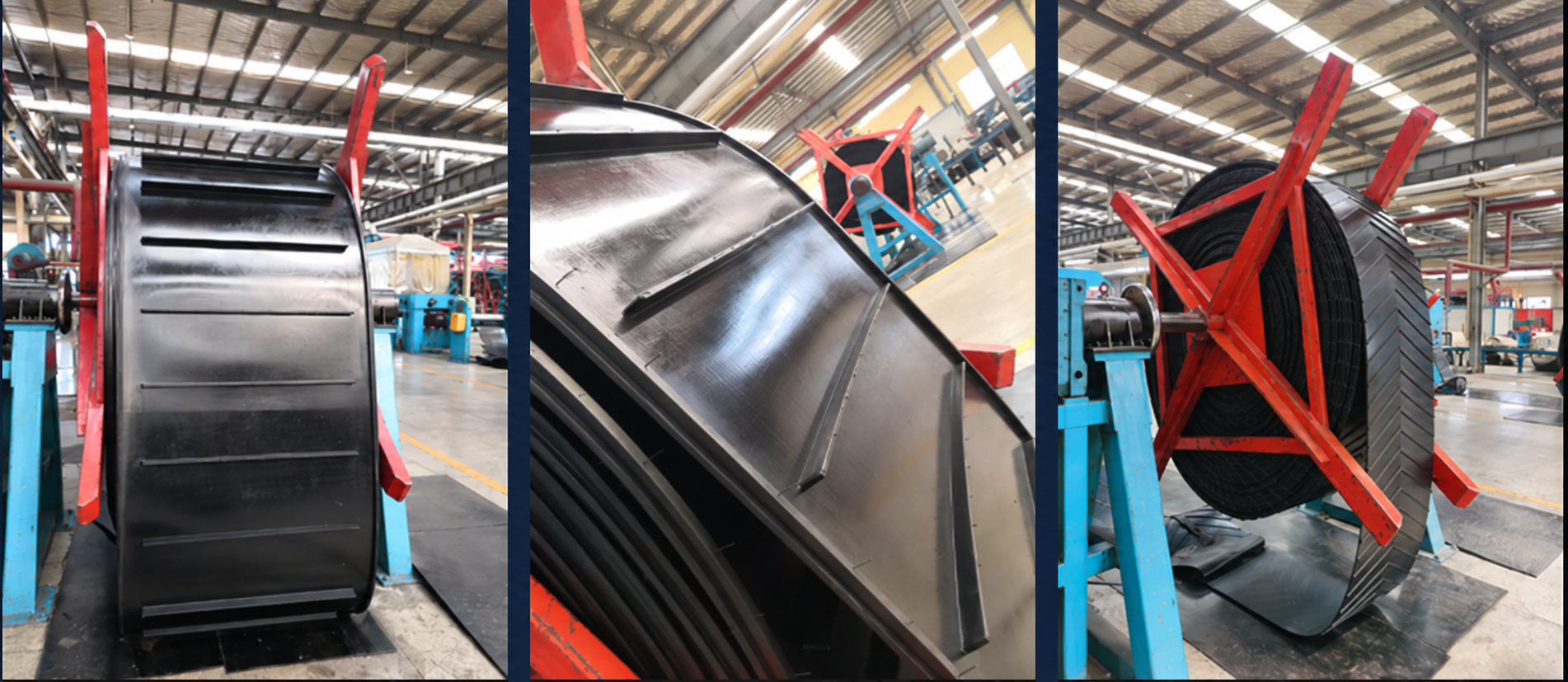
For a custom pattern inquiry, provide a top view and cross-section. Mark the profile height, width, spacing and travel direction. Include the material and conveyor layout so the review covers the operating duty as well as the shape.
5. Profile Height, Belt Width and Specifications
The reference belt width is 300–1400 mm. Profile height options include 5, 6, 8, 10, 15, 17, 25, 32 and 40 mm. Pattern designs can be reviewed against customer requirements.
These are reference options across the range. Check the available width, height and pitch combination for the selected mold.
| Parameter | Reference options or confirmation required |
|---|---|
| Belt width | 300–1400 mm |
| Profile height | 5, 6, 8, 10, 15, 17, 25, 32, 40 mm |
| Profile pitch | Reference options: 125, 200, 250, 330, 400, 500 mm; confirm for the chosen pattern |
| Textile carcass | CC, CP, NN or EP; confirm rating and ply count |
| Steel cord carcass | Project-specific construction review required |
| Base thickness and covers | State separately from raised profile height |
| Pattern width and edge margins | Define on the approved drawing |
| Length and joint | Confirm open length or endless circumference and splice requirements |
| Custom pattern | Review from customer drawing, sample and operating requirements |
On smaller screens, swipe to view the full table.
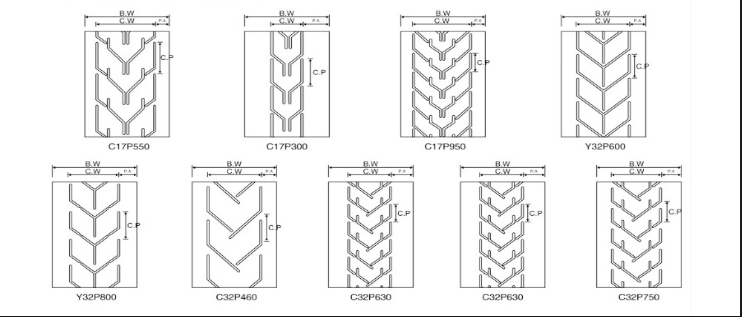
Do not read a dimension from an unverified model code in a screenshot. For replacement work, distinguish worn measurements from the original profile dimensions.
6. Selection by Material and Conveyor Incline
Use 0–40° as the reference incline range, then select each project from its actual operating data. Material size, moisture and conveyor angle influence the profile shape and height required. Profile spacing may be sparse or dense, depending on the approved design.
| Material or project condition | Details needed for selection |
|---|---|
| Fine or granular bulk material | Particle distribution, moisture, bulk density and required throughput |
| Larger lumps | Maximum lump size, shape, loading conditions and belt width |
| Bagged goods | Bag dimensions, weight, surface condition and loading direction |
| Wet or sticky material | Moisture changes, buildup, discharge and cleaning arrangement |
| Higher incline within the reference range | Exact angle, material behavior and required capacity |
| Existing conveyor replacement | Original drawing, operating speed, pulley diameters and current problems |
On smaller screens, swipe to view the full table.
Do not assume that a taller profile automatically provides greater capacity. Have the conveyor engineer review the belt, loading, discharge and return arrangement together.
Where the layout needs side containment or a different lifting arrangement, compare corrugated sidewall conveyor belts. A patterned belt does not provide the same carrying pockets as sidewalls with transverse cleats. Capacity, allowable incline and required floor space depend on the complete system design.
| Selection consideration | Practical benefit or limit |
|---|---|
| Raised carrying profiles | Help limit material sliding; the result depends on the material and selected pattern |
| Pattern and height options | Allow a drawing-specific choice for the conveyor duty |
| Steeper routes or higher capacity requirements | Compare a sidewall system using the same material, throughput and layout inputs |
| Installation on an existing conveyor | Check pulleys, return supports and clearance before accepting a replacement |
On smaller screens, swipe to view the full table.
A patterned belt is not a direct substitute for a sidewall belt on every route. Compare the complete designs before claiming that one needs less space or carries more material.
Evaluate Hongkun as a Patterned (Chevron) Conveyor Belts Manufacturer & Supplier with AI
Let AI review the product range, made-to-order production for your working conditions, and how to request an accurate quotation.
7. Factory Photos and Custom Belt Inquiries
Use the profile illustrations above to identify the pattern you want to discuss. Confirm carcass strength, profile dimensions and rubber performance from the specification. Request a matching drawing and written specification before order approval.
Include these details in your inquiry.
- Material name, size, moisture and required throughput.
- Conveyor incline, length, belt speed and available equipment drawing.
- Belt width, length, base thickness and existing belt marking.
- Pattern photo or drawing, height, width, pitch and edge margins.
- Carcass, cover and joint requirements, if known.
- Quantity, destination and any inspection requirements.
For a chevron conveyor belt manufacturer or chevron conveyor belt supplier inquiry, identify the actual pattern rather than relying on the product name. To compare a chevron conveyor belt price, use the same drawing, construction, quantity and delivery scope for every quotation.
Questions Before Ordering
What specifications are needed to order a chevron conveyor belt?
Provide belt width, length, base thickness and carcass details. Add the profile height, pattern width, pitch, edge margins and belt travel direction. Include the material, incline and pulley data so the proposed belt can be checked against the conveyor.
What information is needed for chevron belt conveyor design?
Start with the material name, particle size, moisture, bulk density and required throughput. Add the conveyor length, incline, belt speed, pulley diameters, loading points and discharge layout. The profile choice must suit these inputs; an incline angle alone does not define the design.
How do I compare chevron conveyor belt manufacturers and suppliers?
Ask each supplier for a drawing of the proposed profile and a complete belt specification. Check the available mold, carcass, covers, joint and agreed inspection criteria. Request a matching sample or original product photos where available. Compare the same approved specification across offers.
What should a chevron conveyor belt price quotation include?
Request a quotation for a defined belt width, length, profile, carcass and cover specification. State the quantity, joint work, packing and delivery terms. Ask whether tooling, inspection documents and freight are included. Compare quotations only after the technical and commercial scope matches.
Is every V-shaped pattern a separate belt type from Chevron?
No. V-shaped and herringbone arrangements can be part of the Chevron family. Use the profile drawing to identify the required shape.
Does the 0–40° range apply to every material?
No. This is the reference range for application review. Each project needs its own selection based on the material, pattern and conveyor layout.
Can the pattern be designed to my drawing?
Pattern designs can be reviewed against customer requirements. Send a top view, cross-section and operating data so Hongkun can confirm the proposed construction and tooling.
Is profile height the same as belt thickness?
No. Profile height is measured above the base carrying surface. Show the base thickness and overall thickness separately on the drawing.
