
Fabric Conveyor Belts
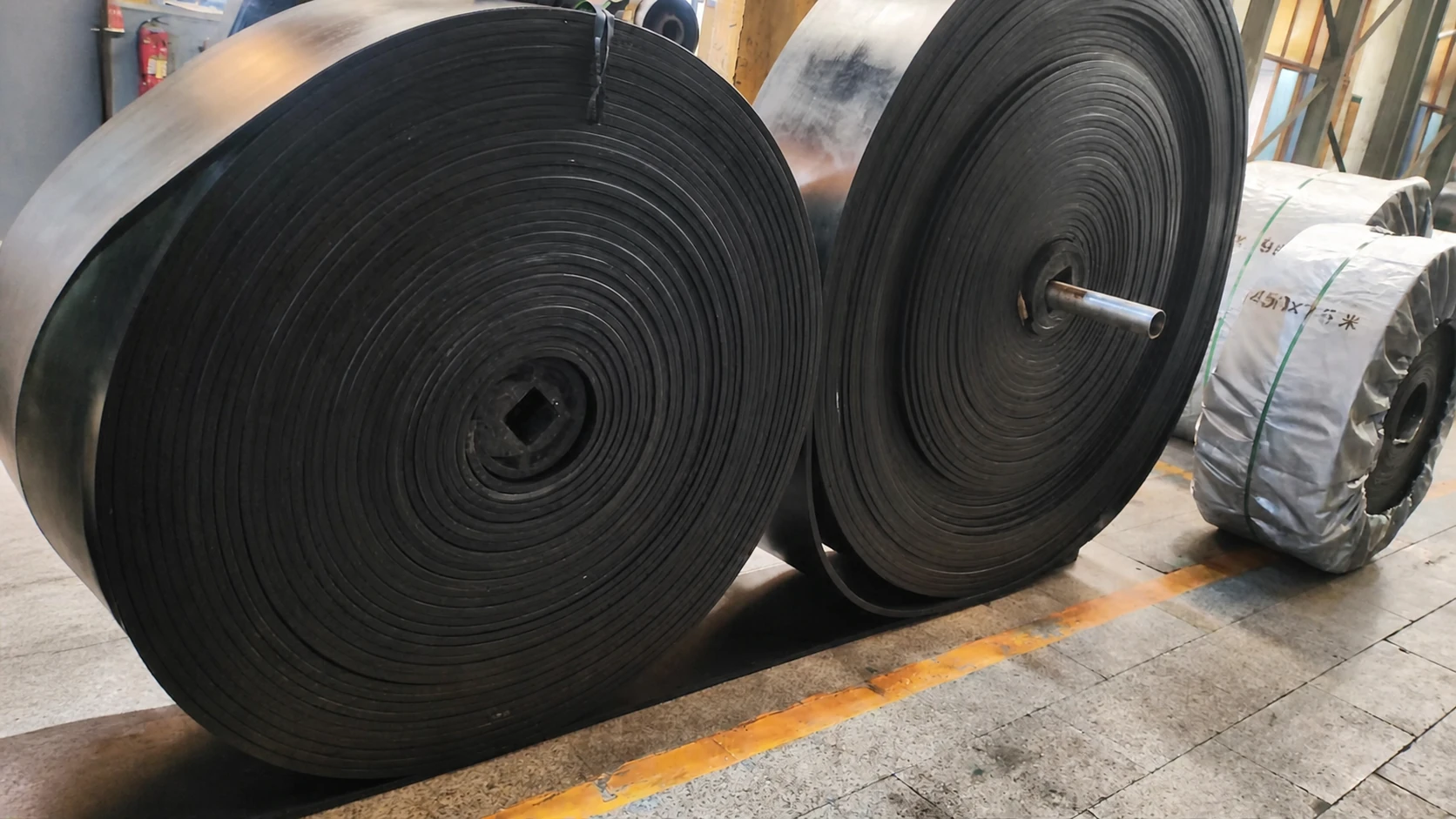
Hongkun supplies fabric conveyor belts for bulk material handling and general industrial conveying. A textile carcass carries belt tension, while upper and lower rubber covers protect the belt on the material side and pulley side.
Use this page to compare EP, NN and CC fabric conveyor belts, review rubber cover options, and prepare the details needed for a quotation. Final belt construction is confirmed against the conveyor layout, material load and operating conditions.
- Carcass options
- EP / NN / CC
- Cover options
- General / Oil / Heat / Flame / Cold / Abrasion
- Belt width
- 300-2800 mm
- Belt length
- 20-1000 m Confirmed per order
Fabric Conveyor Belt Construction
Fabric conveyor belts use textile fabric as the reinforcement layer. The carcass is placed between the top and bottom rubber covers, and rubber skim layers bond the fabric plies into one belt body.
This construction is often selected for short and medium-distance conveying. It can form a trough on carrying idlers, carry powder or lump materials, and run at the speed required by the conveyor design.
| Belt part | Function | What to confirm |
|---|---|---|
| Top cover | Contacts the conveyed material | Cover grade, top cover thickness, abrasion or oil exposure |
| Fabric carcass | Carries belt tension and supports troughing | CC, NN or EP fabric, model, ply count, strength and elongation |
| Skim rubber | Bonds the fabric plies | Compound compatibility and adhesion requirement |
| Bottom cover | Contacts pulleys and return idlers | Bottom cover thickness, pulley condition and operating environment |
Choose the Fabric Carcass: CC, NN, or EP
The fabric code identifies the reinforcement material. It does not replace the complete belt rating, ply count, cover thickness or operating review.
| Fabric type | Main character | Suitable use and quotation notes |
|---|---|---|
| CC cotton canvas | Traditional cotton-fabric carcass | Consider for short and medium-distance general conveying where the old specification already uses CC. Confirm moisture exposure, strength and stretch before replacement. |
| NN nylon | Nylon fabric carcass | The supplied reference describes good elasticity, strength, impact resistance, bending resistance and troughability. Confirm working elongation and take-up travel for the actual conveyor. |
| EP polyester/nylon | Polyester warp and nylon weft fabric | Often selected when lower longitudinal stretch and stable running are important. Confirm the EP model, ply count, tension, pulley diameter and rubber cover grade together. |
For replacement projects, send the belt marking and a clear photo of the cut edge. The same belt width can use different fabric materials, cover grades and ply counts.
Rubber Cover Options for Different Materials
The rubber cover should match the conveyed material and the operating environment. Do not choose the cover only from the belt width or fabric code.
| Cover option | Use when | Quote details to confirm |
|---|---|---|
| General purpose | Powder, granular and small lump materials in normal service | Material name, particle size, belt speed, loading point and abrasion condition |
| Oil resistant | The material contains oil, fat or oily residue | Oil type, concentration, temperature, cleaning method and contact time |
| Acid and alkali resistant | The belt contacts acidic or alkaline material | pH, concentration, temperature, moisture and exposure time |
| Heat resistant | The material temperature is above normal ambient service | Normal material temperature, short peak temperature, lump size and contact time |
| Flame retardant | The working site requires flame resistance | Required standard, test document and site safety rule |
| Cold resistant | The belt runs in low ambient temperature | Lowest operating temperature, start-up condition and storage environment |
| Abrasion resistant | Hard or sharp materials wear the cover after loading | Material hardness, drop height, impact point and expected cover life target |
Heat resistance, oil resistance, flame resistance and chemical resistance are cover or finished-belt properties. They are reviewed together with the fabric carcass, not chosen as a replacement for EP, NN or CC.
Reference Specification Series
Use the specification table to read a belt model and prepare an inquiry. Strength per ply is shown in N/mm; the total belt strength depends on fabric grade, number of plies and the finished construction.
| Belt family | Model | Strength per ply (N/mm) | Fabric ply thickness (mm) | Number of plies | Belt width (mm) | Belt length (m) |
|---|---|---|---|---|---|---|
| CC cotton canvas | CC-56 | 56 | 1.10 mm | 3-12 | 300-2800 mm | 20-1000 m |
| NN nylon | NN100 | 100 | 0.70 mm | 2-10 | 300-2800 mm | 20-1000 m |
| NN nylon | NN150 | 150 | 0.75 mm | 2-10 | 300-2800 mm | 20-1000 m |
| NN nylon | NN200 | 200 | 0.90 mm | 2-10 | 300-2800 mm | 20-1000 m |
| NN nylon | NN250 | 250 | 1.15 mm | 2-10 | 300-2800 mm | 20-1000 m |
| NN nylon | NN300 | 300 | 1.25 mm | 2-10 | 300-2800 mm | 20-1000 m |
| NN nylon | NN400 | 400 | 1.50 mm | 2-10 | 300-2800 mm | 20-1000 m |
| EP polyester/nylon | EP100 | 100 | 0.75 mm | 2-8 | 300-2800 mm | 20-1000 m |
| EP polyester/nylon | EP150 | 150 | 0.85 mm | 2-8 | 300-2800 mm | 20-1000 m |
| EP polyester/nylon | EP200 | 200 | 1.00 mm | 2-8 | 300-2800 mm | 20-1000 m |
| EP polyester/nylon | EP250 | 250 | 1.20 mm | 2-8 | 300-2800 mm | 20-1000 m |
| EP polyester/nylon | EP300 | 300 | 1.35 mm | 2-8 | 300-2800 mm | 20-1000 m |
| EP polyester/nylon | EP350 | 350 | 1.50 mm | 2-8 | 300-2800 mm | 20-1000 m |
| EP polyester/nylon | EP400 | 400 | 1.65 mm | 2-8 | 300-2800 mm | 20-1000 m |
| Reference cover combination | Top cover | Bottom cover | Note |
|---|---|---|---|
| Light to medium service | 3.0 mm | 1.5 mm | Confirm against conveyed material and pulley condition |
| Heavier general service | 4.5 mm | 3.0 mm | Confirm abrasion, impact and belt thickness |
| Heavy cover option | 6.0 mm | 6.0 mm | Confirm flexibility, pulley diameter and total belt thickness |
Confirm width, length, cover thickness and finished belt performance with Hongkun before order approval. A model number alone does not define the full conveyor belt.
How to Read a Fabric Belt Specification
An old belt marking often combines fabric grade, ply count, belt width and cover thickness. Reading each field separately helps avoid ordering the wrong replacement.
| Example field | Example value | What it means |
|---|---|---|
| Fabric grade | EP200 | Polyester/nylon fabric with 200 N/mm strength per ply |
| Fabric layers | 4 Ply | Four fabric plies in the carcass |
| Belt width | 800 mm | Finished belt width |
| Top/bottom covers | 4+2 mm | 4 mm top cover and 2 mm bottom cover |
Example: EP200 / 4 Ply / 800 mm / 4+2 mm explains how to read a specification. It is not a confirmed Hongkun stock item, and the final belt must still match the conveyor duty.
Applications and Selection Notes
Fabric conveyor belts serve many industries, but the application still controls the belt choice. Do not lock one industry to one fixed fabric model.
| Application | Main selection focus |
|---|---|
| Cement and aggregate | Abrasion, impact at the loading point, lump size and cover thickness |
| Mining | Material size, drop height, conveyor tension and pulley diameter |
| Ports | Conveyor length, outdoor exposure, running load and take-up travel |
| Fertilizer and chemical handling | Moisture, oil, chemical medium and rubber compound compatibility |
For hot materials, review the cover requirement with the heat resistant conveyor belt range. For long-distance or high-tension conveyors, compare the design with steel cord conveyor belts. For steep-angle conveying, review a corrugated sidewall conveyor belt instead of using a flat belt alone.
Quote Information to Send
Start your quote request with three basic dimensions: belt length, belt width and finished belt thickness.
| Parameter | Details to send |
|---|---|
| Belt length | Required length in m |
| Belt width | Finished width in mm |
| Finished belt thickness | Total belt thickness in mm |
For hot materials, also provide the normal material temperature and any peak temperature. For other special conditions, note any cold, oil, acid, alkali or flame resistance requirements. If available, include the old belt marking or a photo for reference.
Frequently Asked Questions
What is the difference between EP and NN conveyor belts?
EP uses polyester warp and nylon weft. NN uses nylon fabric. EP is often reviewed when lower longitudinal elongation is important, while NN may suit applications that need more flexibility and impact resistance.
How many plies does a fabric conveyor belt need?
The required ply count depends on belt tension, fabric grade, conveyor length, pulley diameter, take-up travel and loading condition. Send the old marking or conveyor data so Hongkun can review the construction.
Can fabric conveyor belts be made with heat-resistant or oil-resistant covers?
Yes, the fabric carcass and rubber cover are selected together. EP, NN and CC describe the reinforcement, while heat resistance, oil resistance and abrasion resistance describe cover or finished-belt properties.
What information is needed to replace an existing fabric conveyor belt?
Start with belt length, width and finished belt thickness. If available, add the old belt marking or a photo. For special conditions, include the material temperature or any other resistance requirements.
When should I choose steel cord instead of fabric?
Review steel cord construction when the conveyor needs very high tension, long distance or controlled elongation beyond the fabric belt design. The final choice should come from the conveyor design data.
Request a Fabric Conveyor Belt Quote
Send your belt length, width and finished belt thickness through the inquiry page. Add temperature or other resistance requirements for special operating conditions.
