
Hongkun Belting / Textile-reinforced rubber belts
Fire Resistant Conveyor Belt
Hongkun manufactures fire resistant conveyor belts with textile reinforcement and flame-retardant rubber covers on both sides. Nylon or polyester fabric forms the load-carrying carcass. The belt is built through calendering, forming and vulcanization.
These belts are intended for non-corrosive bulk materials, including coal, lumps, granules and powders. Match the belt construction and test requirements to the installation before ordering.
Belt construction
Fire resistance and heat resistance are different properties. Flame-test performance does not establish a hot-material temperature rating. If both are required, specify both in the inquiry.
01 / Product construction
Textile-Reinforced Fire Resistant Rubber Belts
The textile carcass carries belt tension. Top and bottom rubber covers protect the carcass and provide the specified cover performance.
Reinforcement & Dimensions
- Confirm the nylon or polyester fabric construction.
- Select belt strength and ply count for the conveyor duty.
- Agree on width, length and finished belt thickness.
Rubber Covers & Performance
- Specify the top and bottom cover thicknesses.
- Identify the required flame-test criteria.
- Add electrical resistance requirements if the site requires antistatic performance.
See our fabric conveyor belts for carcass selection. The quotation must identify the finished belt construction and its test scope.
02 / Manufacturer-declared specifications
Cover Properties and Flame-Test Criteria
The tables below show Hongkun’s supplied specification values. They are specification limits, rather than measured results from an individual test report.
Rubber Cover Mechanical Properties
Swipe the table to view all columns.
| Cover grade | Tensile strength, minimum (MPa) | Elongation at break, minimum (%) |
|---|---|---|
| D | 18.0 | 450 |
| L | 14.0 | 400 |
D and L describe the supplied cover mechanical-property grades. They do not establish a finished belt’s fire-safety classification.
For 0.8–1.6 mm covers, the supplied sheet permits up to a 15% reduction in tensile strength and elongation values. It specifies the maximum obtainable specimen thickness. Confirm this exception against the agreed test method and report.
Flame-Test Requirements: K2 and K3
Swipe the table to view all columns.
| Item | K2 specification | K3 specification |
|---|---|---|
| Flame duration, specimens with covers | Total for six specimens: ≤45 s. Any individual specimen: ≤15 s. | Average for three specimens: ≤60 s. |
| Flame reappearance | No specimen may show flame reappearance under the specified test conditions. | No specimen may show flame reappearance under the specified test conditions. |
Use K2 or K3 together with the applicable test standard, edition and specimen conditions. Do not assume that these labels are equivalent to K, S or VT designations.
03 / Industry applications
Industry Applications for Fire Resistant Conveyor Belts
Coal handling and thermal power plants are key application areas. Other bulk handling sites may specify fire resistant belts based on their materials and installation requirements.
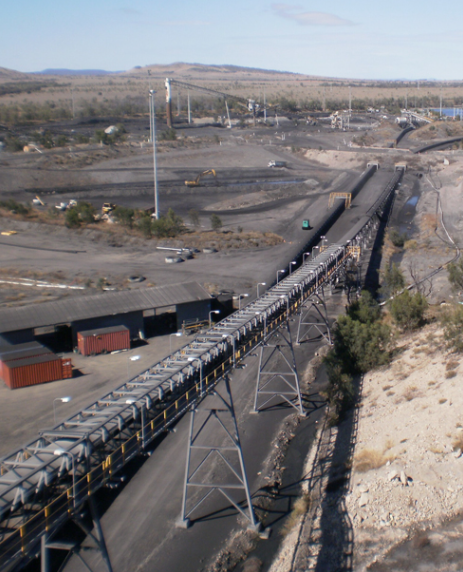
Coal industry
Coal Mining & Preparation
For above-ground coal transport, screening and preparation lines. Confirm lump size, loading impact, abrasion and the required flame-test grade.
Power generation
Thermal Power Plants
For coal receiving, stockyard transfer and fuel feed conveyors. Specify dust exposure and material temperature alongside the fire-performance requirement.
Ports & terminals
Coal Terminals & Loading Facilities
Consider fire resistant belts for coal transfer between unloading, storage and loading areas. Confirm outdoor exposure, conveyor tension and the site specification.
Bulk handling
Storage & Transfer Stations
For non-corrosive lumps, granules or powders where the site requires flame-performance testing. Select cover thickness and carcass strength for the actual load.
Selection depends on the installation. Underground mines and designated hazardous locations need product-specific documents and the applicable approval scope. Hot materials need a separate temperature assessment.
04 / Separate performance requirements
Fire Resistant vs. Heat Resistant Conveyor Belts
Fire resistance concerns the belt’s response to an ignition source under a defined test. Heat resistance concerns service with hot conveyed materials.
Swipe the table to view all columns.
| Requirement | Selection focus | Information to send |
|---|---|---|
| Fire resistant conveyor belt | Flame behavior and other safety properties required for the installation. | Required standard, grade, test method and installation type. |
| Heat resistant conveyor belt | Material temperature, contact time and heat-related belt damage. | Normal and peak material temperatures, lump size and exposure duration. |
| Both properties required | A finished construction supported for both sets of requirements. | The complete flame-test and temperature specification; review the combined construction. |
For hot-material selection, review our heat resistant conveyor belts. Neither property should be inferred from the other.
05 / Product-specific evidence
Match the Test Report to the Finished Belt
Request the relevant test reports when reviewing the quotation. Match each report to the proposed belt construction and the required test conditions.
- Product identity: belt model, carcass, ply count, cover compound and tested thickness.
- Flame testing: standard and edition, specimen condition, measured results and acceptance criteria.
- Electrical testing: resistance value, unit, test method and specimen conditions when antistatic performance is required.
- Report traceability: laboratory, report number, date and applicable product scope.
- Site acceptance: any certificates or approvals required for the destination and installation.
A flame resistant conveyor belt may also need electrical testing. If your specification calls for a FRAS conveyor belt, provide both the fire-resistance and antistatic requirements.
Grade names and marking codes help identify a specification. They do not replace the product-specific test results or approval scope.
06 / Quotation requirements
Send Your Belt Dimensions and Required Test Scope
Start with the dimensions and installation type. Add the required standard and grade so the quotation can address the finished product.
Swipe the table to view all columns.
| Parameter | Details for your inquiry |
|---|---|
| Belt dimensions | Width, length, total thickness and top/bottom cover thicknesses; include units. |
| Carcass and strength | Existing belt marking, fabric type, ply count and belt strength rating. |
| Operating conditions | Material, load, speed, working tension, pulley diameters and take-up arrangement. |
| Fire-performance requirement | Standard, edition, class and required tests; include the site specification if available. |
| Antistatic requirement | Required electrical resistance limit, unit and test method. |
| Temperature and environment | Normal and peak material temperatures; any oil, chemical or outdoor exposure. |
| Order and evidence | Quantity, destination, required date and the reports or approvals needed for acceptance. |
If the old marking is incomplete, send belt photos and a conveyor drawing. The quotation should confirm dimensions, performance scope and delivery terms together.
Evaluate Hongkun as a Fire Resistant Conveyor Belts Manufacturer & Supplier with AI
Let AI review the product range, made-to-order production for your working conditions, and how to request an accurate quotation.
07 / Buyer questions
Fire Resistant Conveyor Belt FAQ
What is a fire resistant conveyor belt?
It is a conveyor belt specified for flame performance under defined test conditions. The finished belt construction and required tests must match the installation.
Is a fire resistant belt also heat resistant?
Not automatically. Flame performance does not establish the belt’s hot-material temperature rating. Specify both requirements if the conveyor carries hot material and requires fire resistance.
What is the difference between fire resistant and fire retardant conveyor belts?
Buyers use both terms when requesting flame-performance properties. A fire retardant conveyor belt inquiry still needs a defined standard, grade and test scope. The wording alone does not establish a pass result.
Does every fire resistant belt have antistatic performance?
Do not infer electrical performance from flame performance. Request the required electrical resistance test and check its value, unit and method against the site specification.
Are K2 and K3 the same as K and S?
Do not treat these labels as interchangeable. Confirm the complete standard, edition, specimen conditions and acceptance criteria behind each designation.
Can these belts be used in underground coal mines?
Underground use requires review of the applicable installation requirements and product-specific documents. A general textile rubber belt description or flame-test grade does not establish mine approval.
What affects the fire resistant conveyor belt price?
Price depends on dimensions, carcass strength, ply count, cover compound, thickness, quantity and the required testing or documents. Send the complete specification for an order-specific quotation.
