
Conveyor Belt Splicing: Why Your Joints Keep Failing and What Actually Fixes It
The belt was re-spliced in March. By June it was lifting at the same joint again. Most conveyor belt splicing problems are treated as a workmanship issue. Many of them are not.
If you run maintenance at a plant, or you are the contractor who gets called back to the same joint again and again, this pattern will feel familiar. The crew is blamed, the adhesive is changed, and the line goes down for another full day.
This guide explains how conveyor belt splicing works, the signs a joint is failing, the causes most people miss, what a failing joint really costs, and what a belt manufacturer sees from the factory side.
Key Takeaways
- A splice is usually the weakest point of a conveyor belt, and its strength is capped by the belt’s own ply adhesion.
- Repeat failures at the same joint usually point to the belt, the splice length, the pulley size or an out-of-square joint, not only the crew.
- For fixed-length machines, a belt joined in the factory removes the site joint as a failure point.
- Proof: Hongkun’s patented jointless shot blast belts typically last at least a year where belts were changed every three months (see the results). An Indonesian foundry doubled the joint life of its heat-resistant belts with factory-joined belts (see the case).
What Is Conveyor Belt Splicing?
Conveyor belt splicing is the process of joining the two ends of a belt to form a continuous loop. The three main methods are hot vulcanizing, cold bonding and mechanical fastening.
The splice is where the belt’s carcass is cut and rebuilt. That makes it, on most belts, the weakest point of the whole loop.
A splice is usually the weakest point of a conveyor belt. Rated belt strength does not equal splice strength.
Signs Your Splice Is Failing
Most operators notice the symptoms long before the joint breaks. Check your belt against this list:
- Lifting edges at the start or end of the splice, where the cover rubber begins to curl up.
- Cover peeling along the steps, showing the fabric plies underneath.
- Cracks running across the splice, often starting at one edge.
- Mistracking every time the joint passes a pulley, while the rest of the belt runs straight.
- Bulges or blisters inside the splice area.
- On bucket elevator belts, tearing at the bolt holes near the joint.
- The same joint failing again within weeks or months of being re-spliced.
If two or more of these sound familiar, the problem is rarely bad luck.
Why Conveyor Belt Joints Fail: It Is Usually Not the Glue
When a joint fails, the first suspects are the splicing crew and the adhesive. Those can be the cause. But when the same joint keeps failing after good crews and fresh materials, the cause is usually somewhere else.
| What people usually blame | What is often the real cause |
|---|---|
| Poor workmanship | The belt’s own ply adhesion is too weak to hold any splice |
| Bad adhesive | Splice and step lengths were not calculated for the belt’s strength |
| “Old belt” | Pulley diameter is too small for the ply count, so the joint is over-flexed every turn |
| Bad luck | The splice method does not suit the duty (heat, impact, frequent starts) |
| The new belt section | Two belts of different makes or specifications were joined together |
| Mistracking from the structure | The splice was cut or joined out of square, so one edge carries more tension |
1. The belt itself cannot hold a strong splice
A vulcanized splice works by bonding rubber to the fabric plies. If the belt was built with weak adhesion between plies, low-grade fabric or recycled rubber, the splice has nothing solid to bond to.
A splice can never be stronger than the ply adhesion of the belt it joins.
This is why replacing the crew or the adhesive often changes nothing. The limit was set when the belt was made.
2. Splice length does not match belt strength
Higher-strength belts need longer steps so the load can transfer from ply to ply. A splice cut short to save time, or to save belt length, concentrates stress at the step ends. That is where cracks start.
3. The pulley is too small for the belt
Every pass over a pulley bends the splice. A pulley that is too small for the belt’s ply count bends it harder than it was designed for, and the steps begin to separate.
4. The splice method does not suit the duty
Cold bonding is fast but less tolerant of heat. Mechanical fasteners are quick to install but wear and pull out under heavy impact. Hot vulcanizing gives the strongest joint but needs the right equipment, time and conditions.
5. The joint is out of square or the loop is the wrong length
If the belt ends are not cut square, or the finished loop ends up longer or shorter than the machine needs, one edge runs tighter than the other. The belt mistracks, the tight edge carries more load, and the splice cracks from that side first. On machines with fixed take-up travel, a wrong loop length can make the belt hard or impossible to tension correctly.
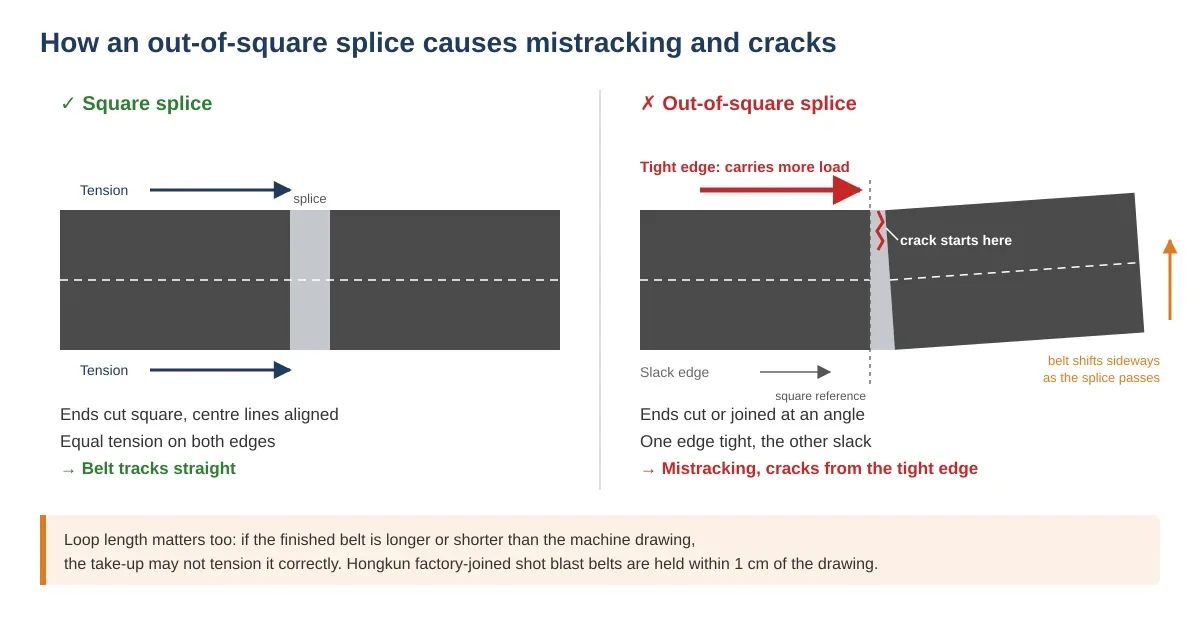
If the belt wanders even away from the joint, work through our conveyor belt mistracking troubleshooting guide as well.
When customers send us photos of failed splices, we look at the belt before the joint. In Hongkun’s experience, many repeat failures come from the belt construction or from loop length and squareness, not from the splicing crew. If a joint has been redone several times and keeps failing in the same way, check the belt specification and the machine geometry before booking another splice.
Joint keeps failing? Send us a photo of the failed splice and your belt specification. We will tell you whether the cause is more likely the splice, the belt or the machine.
The Real Cost of a Joint That Keeps Failing
A failed splice costs far more than the splicing job itself. Each repeat failure adds up in four ways:
- Unplanned downtime. A hot vulcanized splice can stop a line for most of a shift or longer. On a production line, lost output is usually the largest cost.
- Repeated splicing charges. Crew, travel, press hire and materials are paid again every time.
- A belt that keeps getting shorter. Every re-splice cuts away belt. Eventually the loop is too short for the take-up, and the whole belt must be replaced early.
- Equipment and safety risk. A joint that tears open under load can damage pulleys, idlers and buckets, and puts people near the line at risk.
Use this simple check for your own line:
| Item | Your figure |
|---|---|
| Splice failures per year | |
| Hours of downtime per failure | |
| Lost output per hour of downtime | |
| Cost of each re-splice (crew, press, materials) | |
| Annual cost of the problem | failures × (downtime × lost output + re-splice cost) |
When this number is compared with the price difference of a better belt or a factory-made endless belt, the decision often becomes simple.
Proof from the Harshest Duty: Shot Blast Machine Belts
Patented · CN 211589771 UIf you want to know whether a belt joint is really solved, look at where joints have the hardest life. Few belts work harder than the tumble belts inside crawler-type shot blast machines.
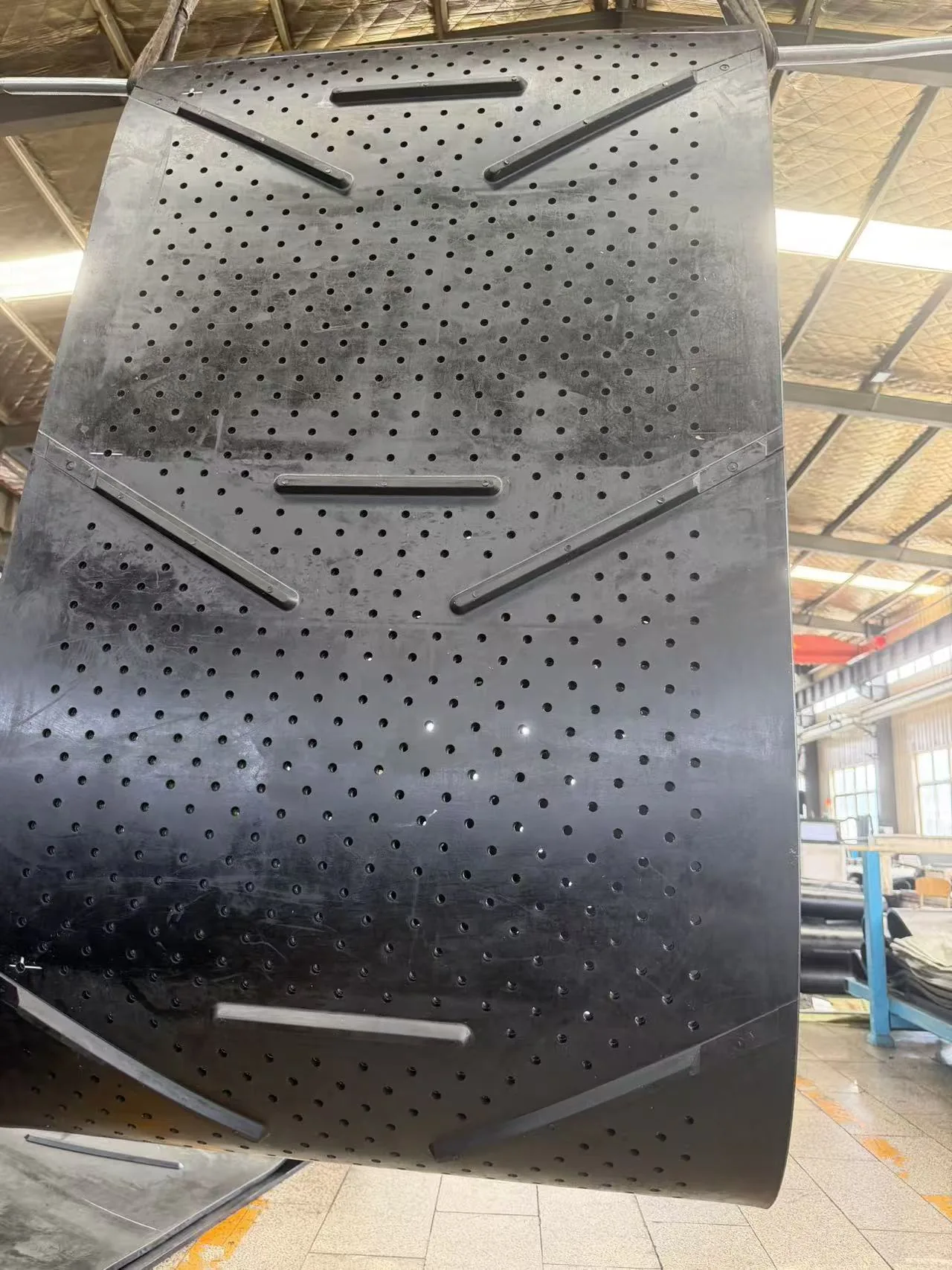
These belts run almost continuously, flex around small rollers, and are hit nonstop by steel shot and abrasive. They are also built to a fixed machine drawing: the loop length, the drain-hole pattern and the guide features must all match the machine. A joint that is weak, thick or the wrong length shows up quickly in this duty.
This is the application Hongkun designed its jointless belt for.
A jointless shot blast belt, protected by a Chinese patent
Hongkun holds Chinese utility model patent CN 211589771 U, Jointless Shot Blasting Machine Track, granted on 29 September 2020.
The belt is formed in one piece, so it does not need a splice. That means fewer vulcanizing steps, higher belt strength, less risk of breakage and a longer service life.
What “seamless” means for the customer
- No visible joint. When the customer receives the belt, the joint position cannot be seen from the outside.
- Length matched to the drawing. A joint made on site normally needs extra belt left for splicing, and the final loop length is hard to control. In Hongkun production, the finished loop is held within 1 cm of the drawing length.
- No splicing on site. The belt arrives ready to fit. The maintenance team installs it; it does not build it.
- High wear-resistant compound. Hongkun pairs the seamless construction with a high wear-resistant rubber compound developed for continuous shot blasting duty.
Find the joint
The camera circles the whole loop of a belt made for Korea: try to find the joint. Watch on YouTube
A belt joint that is never made on site cannot be made badly on site.
The same lesson applies to any machine built to a fixed drawing: when the length, holes and fittings are fixed, a factory-made loop removes the most common source of failure.
Results in the field
Many of Hongkun’s shot blast belt customers, including a foundry in Indonesia, used to replace their belts about every three months. After switching to Hongkun’s jointless, high wear-resistant belts, they typically run at least one year on a single belt.
3 months → 12+ months
Typical customer result after switching to Hongkun jointless shot blast belts.
4 → 1
Less downtime for changeovers, fewer spare belts in stock, more blasting hours.
On a shot blast machine, the joint and the wear compound decide how often the line stops.
Japanese-level quality without the Japanese price
Many foundries face the same choice. Japanese shot blast belts are, without question, high quality. They are also expensive, and for a plant that changes belts several times a year, that cost adds up quickly.
Hongkun belts cost less than Japanese belts, but their quality is recognized by Japanese companies. Hongkun has worked with several Japanese-invested companies, which hold their suppliers to Japanese quality expectations, and our belts are accepted in that supply chain.
For buyers, this means a belt that meets the standard Japanese-invested plants require, at a lower price that makes regular replacement affordable.
Hongkun shot blast belts: quality recognized by Japanese-invested companies, at a lower price than Japanese belts.
See Hongkun’s shot blasting machine belts and tracks and the full range of shot blast machine spare parts.
Case: An Indonesian Foundry Doubled Its Heat-Resistant Belt Joint Life
Case · Indonesia · FoundryA foundry in Indonesia came to Hongkun with a problem it had not been able to solve: the joints on its heat-resistant conveyor belts kept failing, and repeated on-site splicing had not fixed it.
Instead of supplying belt on a roll for another site splice, Hongkun built the complete heat-resistant conveyor belts in the factory to the customer’s dimensions. They arrived already joined, ready to install, with no splicing needed on site.
Result: according to the customer, the service life of the belts at the joint roughly doubled compared with the belts they had used before.
Heat-resistant belts make site splicing harder. The splice rubber must match the belt’s heat-resistant cover compound and be cured correctly, which is difficult to control in a hot, busy foundry. Joining the belt in the factory removes that risk.
On small screens, swipe the table sideways.
| Before | After | |
|---|---|---|
| Supply | Belt joined on site | Complete belt, joined in Hongkun’s factory |
| Site splicing | Required, repeated after failures | None |
| Joint life | Short; repeated failures | About twice as long (customer feedback) |
The foundry now buys from Hongkun as a one-stop supplier: heat-resistant conveyor belts for its casting lines and jointless belts for its shot blast machines, from one factory and on one order.
The lesson for other plants: when a joint keeps failing on site, moving the joint into the factory, where length, squareness, pressure and curing can be controlled, is often the fix that site repairs cannot deliver.
Running belts in a foundry? See Hongkun’s conveyor belts and rubber parts for foundries.
Conveyor Belt Joint Types Compared
Hot vulcanizing gives the strongest and longest-lasting joint for heavy-duty rubber belts. The other methods trade strength for speed or convenience.
On small screens, swipe the table sideways.
| Splice type | How it works | Relative joint strength | Downtime to install | Best suited to |
|---|---|---|---|---|
| Hot vulcanized splice | Ends are stepped, layered with uncured rubber, then cured under heat and pressure | Highest | Longest; needs a vulcanizing press | Heavy-duty, high-tension and continuous-running belts |
| Cold splice (cold bonding) | Ends are stepped and bonded with a cold-curing adhesive | Medium | Moderate; no press needed | Repairs and sites without a press; lower-temperature duty |
| Mechanical splice | Metal fasteners clamp or hinge the belt ends together | Lowest | Shortest | Emergency repairs, light to medium duty, belts that must be opened often |
| Finger splice | Ends are cut into interlocking fingers and vulcanized | High | Long | Solid-woven and some single-ply belts |
| Factory-made endless belt | The loop is built or vulcanized in the factory to the machine’s exact length | Highest; no site joint to fail | None for splicing on site | Fixed-length machines such as bucket elevators and shot blast machines |
Most multi-ply rubber conveyor belts use a step splice, where each ply is cut back in stages so the load passes from one ply to the next across the joint.
Steel cord belts use a different splice construction, with the cords laid in overlapping patterns rather than stepped plies. For those, see steel cord belt splice failure: causes and inspection.
Hot Vulcanizing Procedure and Splice Length
A hot vulcanized step splice follows the same basic sequence on most fabric belts. Always follow the belt manufacturer’s and the splicing compound supplier’s instructions for your specific belt.
- Measure and mark. Mark the centre line on both ends and cut them square. A splice that starts out of square will run out of square.
- Cut the bias and steps. Cut the ends at a bias angle, then strip back one ply per step on each end.
- Buff and clean. Buff the exposed plies to a clean, rough surface without cutting into the fabric.
- Apply cement and tie gum. Coat the surfaces and lay uncured rubber between the plies.
- Join and lay the cover. Bring the ends together step to step, then fill the cover with uncured cover rubber.
- Cure in the press. Heat and press the splice at the temperature, pressure and time set for the compound.
- Cool under pressure and inspect. Let the splice cool before releasing the press, then check for blisters, voids and edge alignment.
How long should the splice be?
Splice length grows with the number of plies and the belt’s strength. For a step splice on a multi-ply fabric belt:
Lsplice = (n − 1) × Lstep + Lbias
Where n is the number of plies, Lstep is the step length per ply, and Lbias is the extra length created by the bias cut (belt width × tan of the bias angle).
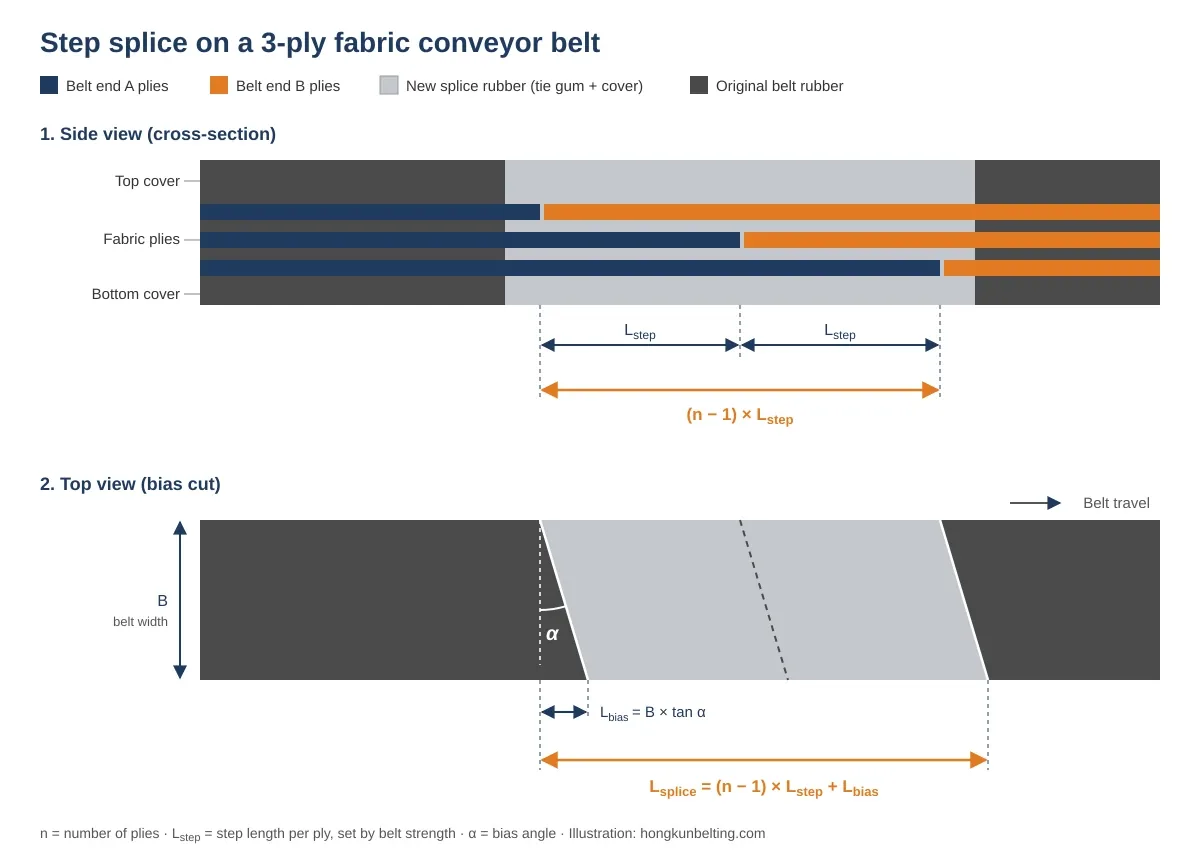
Step length is set by the belt’s strength and ply count. Ask your belt supplier for the recommended value for your exact belt before cutting.
A longer splice uses more belt. Cutting steps short to save length is one of the most common reasons a new splice fails early.
Bucket Elevator Belt Splices
Bucket elevator belts put extra demands on the joint. The joint must carry the full load of the buckets, pass over head and boot pulleys every cycle, and keep the bolt holes in line with the bucket spacing.
Bucket elevator belts are commonly joined with a lap joint, a butt joint with clamping plates, or a vulcanized splice. Whichever method is used, check three things:
- Bucket bolt holes stay clear of the splice ends, so holes do not weaken the joint.
- Bucket spacing stays even across the joint, so the buckets do not clash with the head or boot.
- Belt strength and carcass type suit the lift height and load. Steel cord carcass belts are used for high lifts and heavy loads.
See Hongkun’s bucket elevator belts, with steel cord and fabric carcass options.
What Buyers Should Verify Before Splicing or Ordering an Endless Belt
Before you book another splice or order a new belt, confirm these points with your supplier:
- Belt construction: carcass type (EP, NN, steel cord), number of plies and rated strength, and whether the supplier can show test results for ply adhesion.
- Cover grade and thickness: matched to the material, temperature and wear on your line.
- Pulley diameters: your smallest pulley is large enough for the belt’s ply count.
- Splice method and length: suited to your duty, with step lengths set for the belt’s strength.
- Loop length tolerance: for fixed-length machines, how close the finished loop will be to your drawing.
- Factory-made option: whether the belt can be supplied endless, already joined, so no site splice is needed.
- Documents: a test report that matches the specification you are buying, not just a sample.
- Drawing: for bucket elevators, shot blast machines and other special belts, send the drawing so holes, fittings and length are made to fit.
Rated belt strength is a property of the belt. Splice strength is a property of the joint. Ask about both.
If your machine has a fixed length, Hongkun can supply endless conveyor belts joined in the factory to your drawing, so there is no splice to make on site.
Not Sure Whether the Problem Is the Splice, the Belt or the Machine?
Send Hongkun photos of the failed joint, your belt specification and your working conditions. For bucket elevators, shot blast machines and other fixed-length machines, upload the drawing as well. We will tell you where the failure is most likely coming from and whether a factory-made endless belt would solve it.
- Photos of the failed splice (close-up and full width)
- Belt specification: width, strength, plies, cover grade, length
- Working conditions: material, temperature, speed, pulley diameters
- Machine drawing or model, for fixed-length machines
Research This Topic with AI
Let AI verify the key technical points against independent sources, separate Hongkun’s manufacturing experience from industry standards, and turn this article into practical buying decisions.
Conveyor Belt Splicing FAQ
What is the strongest type of conveyor belt splice?
A hot vulcanized splice is the strongest site-made joint for multi-ply rubber belts. A belt made endless in the factory avoids a site joint altogether.
Why does my conveyor belt joint keep failing after re-splicing?
If good crews and fresh materials do not fix it, look at the belt’s ply adhesion, the splice length, pulley diameters, and whether the joint is square and the loop length is correct.
What is the difference between hot and cold splicing?
Hot splicing cures the joint under heat and pressure in a press. Cold splicing uses a cold-curing adhesive without a press. Hot splicing is generally stronger and better for heavy, continuous duty.
When should I use a mechanical splice?
For emergency repairs, lighter duty, or belts that must be opened often. Mechanical fasteners are fast to fit but usually wear faster under heavy impact.
How long does a conveyor belt splice last?
It depends on the belt, the splice method, the workmanship and the duty. A well-made vulcanized splice on a suitable belt should last close to the life of the belt itself.
How do I check a splice for failure?
Inspect for lifting edges, cover separation along the steps, cracks across the joint, blisters, and mistracking at the joint. Check after the first days of running and then at regular intervals.
Does Hongkun supply endless belts already joined?
Yes. Hongkun supplies belts made to the customer’s drawing and joined in the factory, so they can be installed without splicing on site.
What is Hongkun’s jointless shot blast belt?
It is a shot blasting machine belt formed in one piece, protected by Chinese utility model patent CN 211589771 U. The joint is not visible, and the finished loop is held within 1 cm of the drawing length. Many customers who used to replace belts about every three months now run Hongkun belts for at least a year.
