
How to Measure a Tumble Blast Machine Rubber Track for Replacement
Hongkun can manufacture the replacement rubber track completely to your required dimensions. Once the key dimensions are confirmed correctly, the finished track will fit your machine correctly.
For a quick quotation, send the overall width, outside perimeter, base thickness, and hole diameter. Even machines with the same brand and model can use different dimensions, so the actual measurements are more important than the model number alone.
Why Accurate Measurement Matters
Hongkun does not rely only on a machine model. Every replacement rubber track can be customized to the dimensions required by the customer. The three dimensions that determine the basic machine fit are the overall width, outside perimeter, and base thickness.
When these dimensions are measured and confirmed correctly, the replacement track can be manufactured to fit the machine correctly. Hole diameter is then selected to suit the workpieces, blasting-media diameter, and blast-wheel power.
Tools and Preparation
Prepare a flexible steel tape, straight ruler, vernier caliper, removable marker, camera, machine nameplate information, and any existing drawing.
Before measuring, stop and isolate the machine under its manufacturer’s instructions and site lockout/tagout rules. Remove shot, dust, and deposits that could distort readings.
Whenever practical, measure the removed track relaxed and flat. Do not treat an in-machine tensioned reading as a manufacturing dimension. Report stretching, distortion, repairs, or breakage. Never approach the machine until all applicable safety requirements are completed.
How to Measure a Tumble Blast Rubber Belt: Essential Dimensions
Use millimetres consistently and record dimensions on a marked sketch. Do not round readings to match a familiar model reference.
Step 1: Overall Track Width — W
Measure across the complete track at right angles to its running direction with a ruler or steel tape. Measure from outer edge to outer edge at several positions to expose wear, distortion, or variation.
Record every reading rather than only an average. Photograph the full width with the ruler at both edges.
Step 2: Total Perimeter or Endless Length — L
Remove the endless track, let it relax, mark a start, and run a flexible steel tape along one reference surface for a complete circuit. Record whether L is the inside or outside perimeter. If measuring inside the machine, also record remaining take-up travel and whether the tension roller is at the beginning, middle, or end of its stroke.
If broken, lay the complete belt flat without stretching and measure end to end. Note any elongation: a worn length is evidence, not automatically the new manufacturing length.
A simple inside-to-outside conversion is only a geometric reference. Multiple rollers, thickness, cleats, deformation, and reinforcement introduce error. Hongkun normally uses the outside perimeter (Lₒ) as the production reference. State clearly whether your reading is the inside or outside perimeter so the team can reconcile it with the old track, machine take-up position, and approved drawing.
Case Example: A Customer Drawing with an Inside-Perimeter Reference
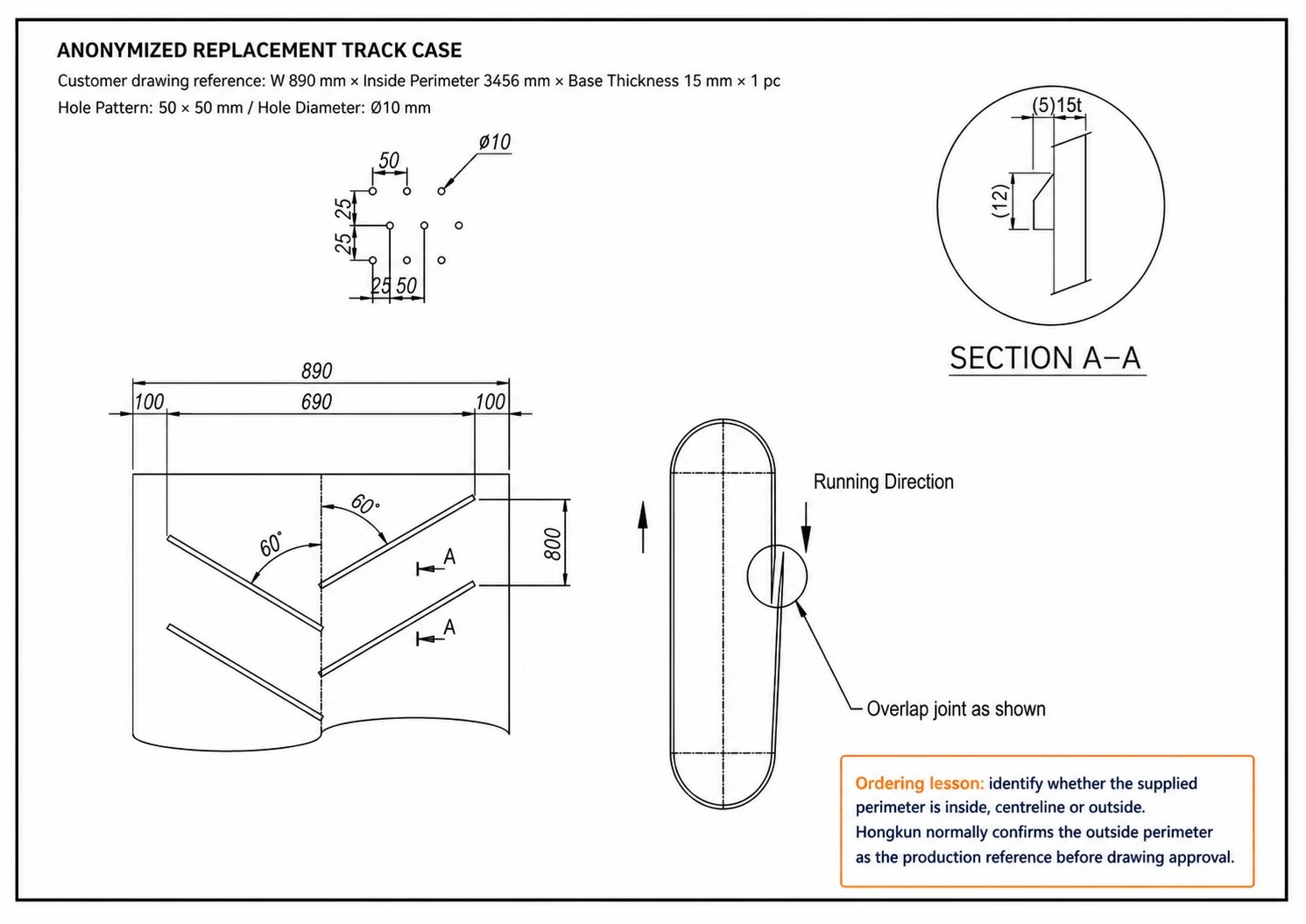
An anonymized customer drawing specified a track width of 890 mm, an inside perimeter of 3,456 mm, a 15 mm base thickness, a 50 × 50 mm hole pattern, and Ø10 mm holes. It also showed two 100 mm edge margins, a 690 mm working width, 60° chevron legs, and an 800 mm rib pitch. These values are User-provided drawing data, not universal dimensions.
The drawing is useful because it labels 3,456 mm as the inside perimeter. Hongkun should not relabel that number as the outside perimeter or use a simple thickness formula as the final order value. The engineering team normally confirms the outside perimeter for production by reviewing the labelled customer datum together with belt construction, the old track or sample, machine geometry, and take-up position. The final outside-perimeter value belongs on the approval drawing.
Step 3: Base Belt Thickness — T
Use a vernier caliper on the base belt away from cleats, joints, repairs, embedded media, and severe wear. Take at least three readings. Record the most nominal-looking thickness, the most worn thickness, and any unusually thick or repaired area separately.
Do not use the minimum worn reading as the required new-track thickness. Photograph the caliper position and surrounding base belt.
Step 4: Hole Diameter — D
Measure hole diameter D at several undamaged holes near the belt edges or between ribs. Holes in the direct-blasting hot spot may become enlarged and oblong through continuous media erosion.
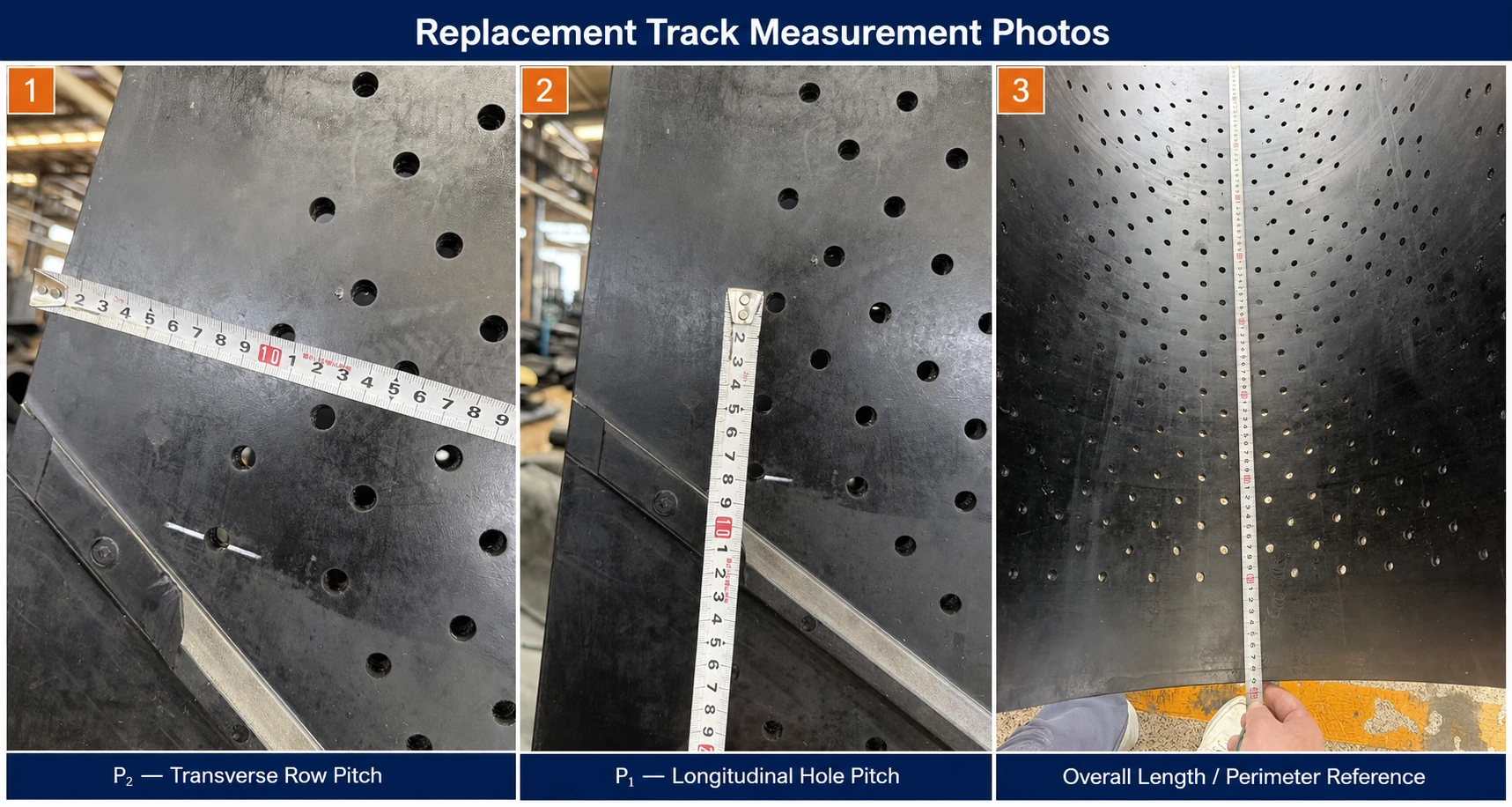
For the initial quotation, the hole diameter and a clear top-down photograph are normally sufficient. If the pattern cannot be confirmed from the photograph, Hongkun may later ask for longitudinal pitch P₁, transverse row pitch P₂, or a drawing before production.
Step 5: Cleat or Herringbone Rib Dimensions
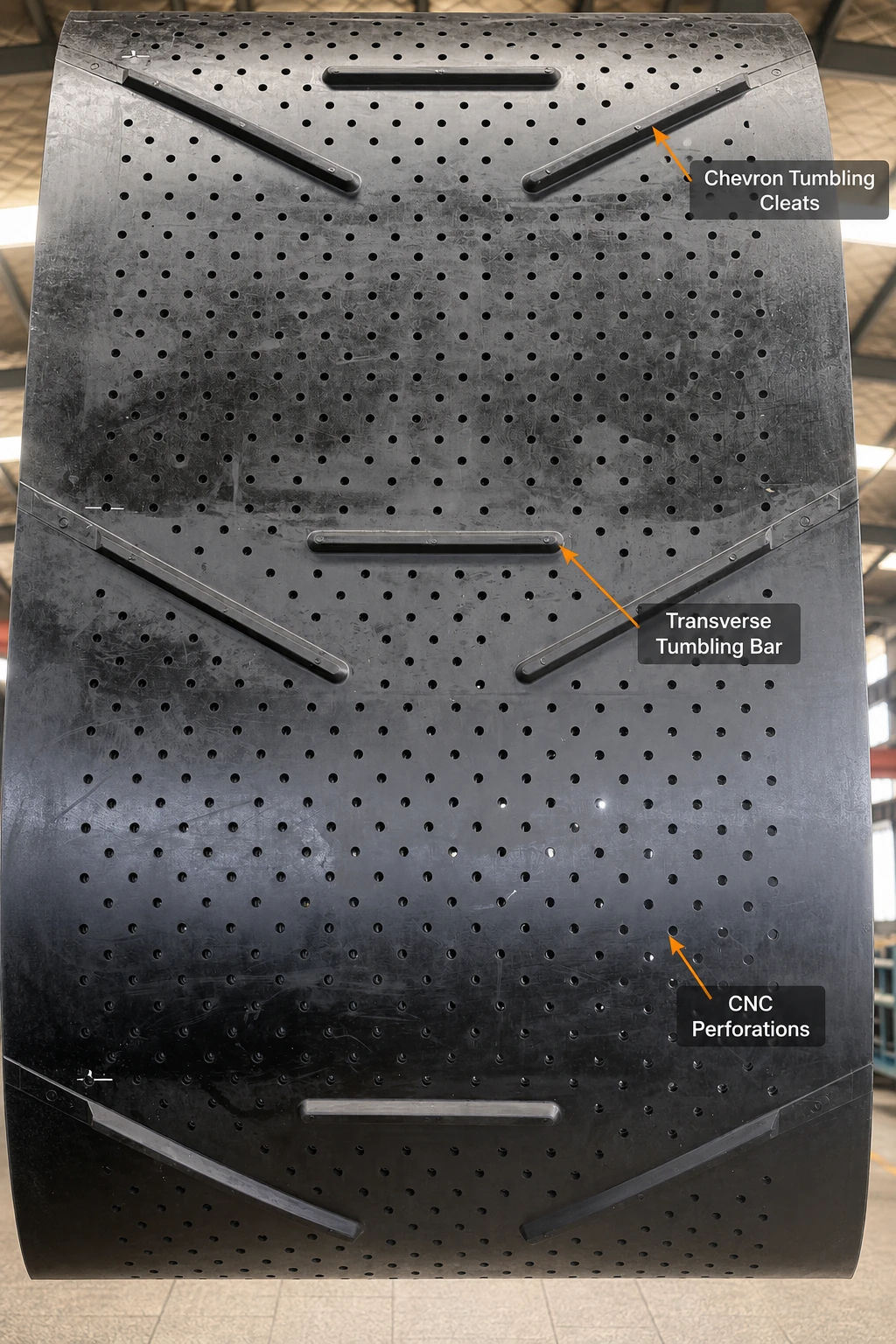
You do not normally need to measure every cleat dimension for the first quotation. Send a clear full-track photograph showing the chevron tumbling legs, transverse bars, and running direction. Hongkun will ask for cleat height, pitch, angle, or edge distance only when the photograph, old sample, or existing drawing is insufficient for production confirmation.
How to Confirm Cleat Direction
Before removing the old track, mark the machine running direction and track running direction. Take wide and close-up photographs showing the chevron tumbling legs, transverse tumbling bars, or other ribs relative to that direction. Photograph both surfaces and identify the loading side.
For the Hongkun chevron structure covered by this guide, the chevron opening faces the belt’s running direction. Mark and photograph that relationship before removal; do not guess from a single photograph of a loose track. Hongkun shows the running arrow and chevron orientation on the approval drawing for checking against the original track and machine structure.
Helpful Information for a Faster Review
The four basic measurements are enough to start: width, perimeter, thickness, and hole diameter. If convenient, also send:
- Machine brand, model, and nameplate photograph
- One full-track photo and close-ups of the holes and ribs
- Required quantity and destination country
- Any existing drawing or old sample information
Workpiece data, hole pitch, cleat details, and joint construction can be confirmed later if the application or replacement structure requires them.
Common Measurement Mistakes
Four Measurements Needed for a Quick Quotation
Start with these four items. Hongkun can review the photos and request any additional production details later.
Swipe horizontally to view the complete table.
| Item | Symbol | What to measure | Recommended photo |
|---|---|---|---|
| Overall width | W | Complete transverse width; state whether side edges are included | Full-width ruler view |
| Total perimeter | L / Lₒ | One full circuit; identify whether the reading is inside or outside. Hongkun normally uses outside-perimeter data for production. | Start mark and final tape reading |
| Base thickness | T | At least three clean base-belt positions | Caliper position and display |
| Hole diameter | D | Several intact perforations outside the direct-blasting hot spot | Caliper across one hole |
Frequently Asked Questions
What measurements do I need for a quick quotation?
Send the overall width, total perimeter, base thickness, and hole diameter. A machine nameplate photo and one clear full-track photo are helpful. Hongkun can request any additional pattern, cleat, or joint details later if needed for production confirmation.
Should I measure the inside or outside perimeter?
Hongkun normally uses outside-perimeter (Lₒ) data for production. Measure the removed, relaxed track when possible and state clearly whether your reading is the inside or outside perimeter. These values are not interchangeable; the final outside perimeter is recorded on the approved drawing.
Can Hongkun customize a replacement track that fits my machine?
Yes. Hongkun can manufacture the rubber track completely to your required dimensions. When the overall width, outside perimeter, and base thickness are confirmed correctly, the finished track will fit the machine correctly. Hole diameter is selected according to the minimum workpiece size, blasting-media diameter, and blast-wheel motor power. Hongkun checks the supplied measurements, photos, or drawing before production.
What if the old track has stretched?
Report the measured length and state that stretching is suspected. Also provide the tensioning position, old drawings if available, and photographs. Do not shorten the value by guesswork.
Can Hongkun manufacture from an old sample?
Yes. Hongkun accepts physical samples or cut cross-sections for dimensional reverse-engineering and compound analysis. Contact the technical team before dispatch to confirm sample requirements and shipping details.
Why is the minimum workpiece size important?
The smallest workpiece dimensions and shape affect the risk of a part entering or jamming in a perforation. Hole diameter alone is not enough; orientation, pitch, open area, shot size, belt thickness, and edge strength also matter.
What photos should I send for a quick quotation?
Send one machine nameplate photo and one clear photograph of the complete old track. Include close-ups showing the four basic measurements if available. Hongkun can request any additional production-confirmation photos later.
