
How to Choose a Shot Blasting Machine Rubber Track: 5 Key Quality Factors
To choose a shot blasting machine rubber track, check five things: the rubber compound, the textile reinforcement, the vulcanized joint, the hole pattern, and the finished quality. Each one must match the machine drawing, the workpieces, and the way your current track fails.
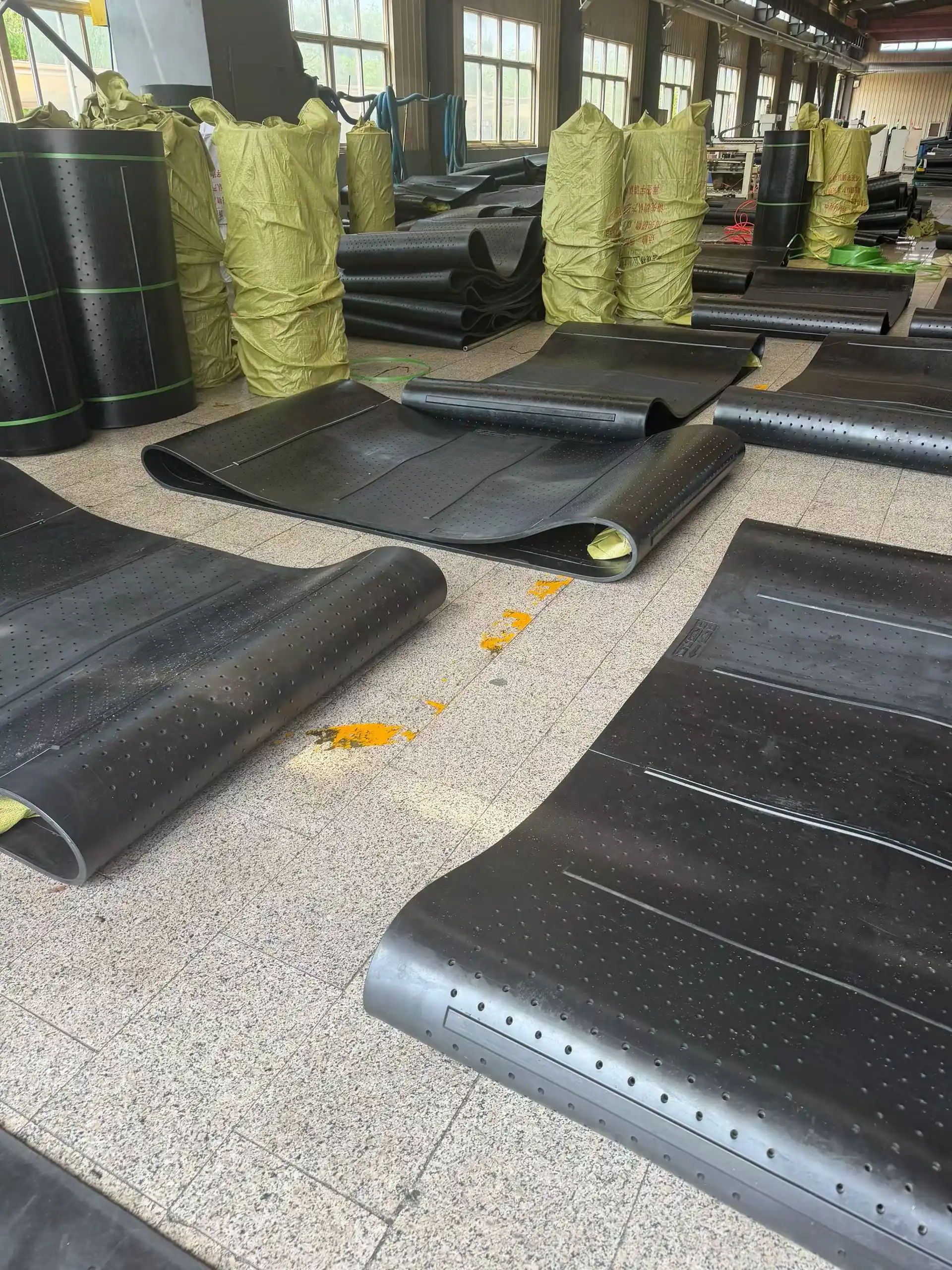
A shot blasting rubber track carries workpieces while flexing around rollers and releasing abrasive through its holes. The best replacement matches both the machine geometry and the actual work.
Why Is a Shot Blasting Machine Rubber Track Different From a Conveyor Belt?
In a tumble blast machine, the track works under conditions that a general-purpose belt never sees together:
- Continuous impact: high-velocity shot and the weight of tumbling workpieces hit the same surface every cycle.
- Constant tension and pressure: the track stays pressed against the drive and guide parts for its whole working life, so the inner surface and edges wear.
- Heat: friction and residual heat from castings can soften, deform and age the rubber.
- Perforations: shot and sand passing through the holes erode the hole edges.
- Fixed geometry: the machine drawing does not change. A track that is too long slips and wanders; a track that is too short will not fit.
This is why track quality varies so widely on the market. Many general rubber belt factories make conveyor belts well but do not build tumble tracks for this combination of duties.
Watch the Shot Blasting Rubber Track in Operation
Start From How Your Current Track Fails
The fastest way to choose a better replacement is to look at the old one. The way a track fails tells you which of the five factors needs attention, and it is the most useful thing you can tell a supplier.
| How the old track failed | Usual cause | What to specify | Hongkun approach |
|---|---|---|---|
| Breaks at the joint | The joint flexes around the rollers every cycle. A conventional splice made with a second vulcanization is the weakest point. | Ask how the joint is made and whether it leaves a raised or visible connection. | Patented jointless track, Hongkun patent CN 211589771 U |
| Wears through or thins out | Shot and castings abrade the working surface; constant pressure wears the inner side and edges. | Compound grade and cover construction for your workpieces and abrasive. | Patented high wear-resistant track, Hongkun patent CN 211589775 U |
| Cut or gouged by workpieces | Sharp edges, burrs and heavy castings tumbling on the surface. | Tell the supplier the workpiece type, weight and edge condition. | Scratch-resistant track design (patent pending) |
| Slips, wanders or will not fit | Finished length differs from the machine drawing; uneven tension. | A written finished-length tolerance against your drawing. | Finished length held within 1 cm of the drawing |
| Holes enlarge or tear between holes | Shot erodes the hole edges; wrong pitch or edge distance concentrates stress. | Hole diameter, pitch, rows and edge distance from the drawing. | Holes made to the customer drawing; hole edges checked before shipment |
| Deforms, hardens or cracks early | Friction heat and residual heat from castings age the rubber. | Workpiece temperature and machine duty. | Compound reviewed for the operating temperature |
Start With the Rubber Compound and Raw Materials
Raw-material quality is the foundation of a shot blasting rubber track. The compound must balance abrasion resistance, tear resistance, elasticity, hardness, adhesion, and repeated-flex performance.
Hongkun uses a high natural-rubber content in its shot blasting track compounds. Natural rubber contributes elasticity, toughness, impact absorption, and flex performance. Hongkun also uses its own compound formulation instead of relying on one generic recipe for every application.
Workpiece duty
The formula can be adjusted for the weight, shape, edges, and impact behavior of the workpieces.
Operating environment
The application review considers the abrasive, loading method, machine duty, temperature, and surrounding conditions.
Complete compound
Natural-rubber content matters, but cure control, fillers, hardness, dispersion, and carcass adhesion must also work together.
Where surface wear is the main problem, compare the standard track with a high wear-resistant tumble belt built for heavier abrasion.
Why Hongkun Uses a Heavy-Duty Nylon Carcass
Hongkun uses a heavy-duty nylon carcass inside the rubber track. The nylon reinforcement carries tension, supports the perforated area, and helps the track withstand repeated loading and impact.
High toughness
Nylon reinforcement helps the track absorb repeated impact from tumbling workpieces.
Repeated flexing
Its flexibility supports continuous bending around the drive and support rollers.
Wear and tear support
The carcass supports the rubber cover and perforated areas, helping the track resist impact-related wear and tearing.
Why a One-Piece Seamless Vulcanized Joint Matters
The joint is a critical part of a shot blasting rubber track because it flexes around the machine rollers during every cycle. A weak or uneven joint can create a local stress point and may fail before the rest of the track.
Hongkun uses an integrated, one-piece vulcanization process to produce a seamless joint. The joint and track form one continuous structure, without a raised mechanical connection interrupting the running surface.
Smooth transition
The seamless joint passes around the rollers without a raised connection point.
More even stress
A continuous structure helps reduce stress concentration during repeated flexing.
Longer service support
Reducing a common weak point helps the track resist joint fatigue and supports longer service life.
Do the Hole Pattern and Length Match the Machine?
Drive holes, perforations, and drainage openings must match the machine. Incorrect diameter, pitch, row position, or edge distance can affect engagement and place extra stress around the holes.
Geometry
Confirm hole diameter, pitch, row spacing, edge distance, and position from a fixed reference point.
Drainage
Confirm that the openings support the intended abrasive-return path and remain clear in service.
Edge quality
Check for rough cuts, cracks, deformation, exposed reinforcement, or early tearing.
Finished length
Length matters more than most buyers expect. Too long, and the track slips and wanders; too short, and it will not fit the machine. Ask every supplier to state the finished-length tolerance in writing against your drawing. Hongkun holds finished length within 1 cm of the drawing.
Cleat height and spacing also affect how workpieces turn over. For a real example, see how we reworked the cleat spacing on a custom track drawing.
What Quality Checks Should Be Completed Before Installation?
A uniform appearance cannot prove every performance claim. It can still reveal obvious manufacturing or handling problems before installation.
- Check width, perimeter, thickness, straightness, and surface consistency.
- Compare cleat size and spacing with the approved drawing or old sample.
- Inspect the edges, holes, and joint for visible damage or irregular work.
- Record receiving photos and measurements before the track enters service.
| Quality factor | What to confirm | Common buying mistake |
|---|---|---|
| Rubber compound | Grade and relevant finished-compound checks | Choosing by rubber percentage or price alone |
| Reinforcement | Heavy-duty nylon carcass and complete construction | Looking only at the fabric code |
| Vulcanized joint | One-piece seamless construction and smooth transition | Ignoring how the joint is manufactured |
| Hole pattern | Diameter, pitch, rows, position, and drainage | Ordering from the machine model alone |
| Finished QC | Dimensions, cleats, edges, surface, and records | Installing before documenting discrepancies |
Once the track passes these checks, follow the storage, cleaning and installation steps before it goes into the machine.
How to Choose a Shot Blasting Rubber Track Supplier
Before you compare prices, ask each rubber track supplier for shot blasting machines the same questions:
- Who makes it? A rubber manufacturer controls compound, carcass and vulcanization. A trading company may not know how the track was built.
- Can they work from your drawing or old sample? Machine model alone is not enough for a replacement track.
- How is the joint made? Spliced and re-vulcanized, or jointless?
- What length tolerance will they put in writing?
- What do they need to know about your work? A supplier who never asks about workpieces, abrasive or temperature is selling a generic track.
- Can they supply the other rubber parts? Rubber curtains and liners are replaced on the same machines and are easier to source together.
— Wang Xinxiang, Sales Manager, Hongkun
If you run Sinto-type machines, see our replacement belts for Sinto SNB-30 and SNB-50Z machines. Sinto is a trademark of its owner; Hongkun tracks are independent replacement parts and are not made or endorsed by Sinto.
Hongkun has made rubber belts since 1985 and builds shot blasting tracks in its own factory in Qingdao. Tracks have also been shipped in repeat orders to a customer in Thailand for more than two years. Hongkun also makes rubber curtains and liners to drawing; see the shot blasting machine spare parts range. For foundries that also run conveyors, the foundry conveyor belt and rubber parts page covers both.
What to send for a quotation
- The track drawing, or measurements of the old track: width, inner circumference, thickness, hole layout, cleats
- The machine type or manufacturer, if known
- Workpiece type, typical weight and temperature
- How long the current track lasts and how it fails (joint, wear, cuts, slipping)
- Quantity and destination
Need to Measure an Existing Shot Blasting Rubber Track?
Correct measurements are essential before ordering a replacement track. Use our step-by-step measurement guide to confirm the width, inner circumference, thickness, hole layout, and cleat arrangement.
Research This Topic with AI
Let AI verify the key technical points against independent sources, separate Hongkun’s manufacturing experience from industry standards, and turn this article into practical buying decisions.
Frequently Asked Questions
What is a shot blasting machine rubber track?
It is the perforated, endless rubber belt that carries and tumbles workpieces inside a tumble (crawler-type) shot blasting machine. It turns the parts over so the shot reaches every surface, and lets shot and sand fall through its holes back to the recovery system.
How long does a shot blasting rubber track last?
It depends on the workpieces, abrasive, temperature and machine condition. Many customers who switched to Hongkun report that a track they used to replace about every three months now lasts at least a year. The lifespan guide explains the factors in detail.
Can I order a replacement track using only the machine model?
Usually not. Machines of the same model can differ in track length, hole layout and cleats after years of modification and repair. Send a drawing or measure the old track.
Why does the joint usually fail first?
The joint bends around the rollers on every cycle while carrying impact load. A conventional splice made with a second vulcanization creates a local stress point, so it tends to break before the rest of the track wears out.
What length tolerance should a replacement track have?
Ask the supplier to state it in writing against your drawing. Hongkun holds finished length within 1 cm of the drawing, because a track that is too long slips and wanders and one that is too short will not fit.
What information do I need for a quotation?
The drawing or old-track measurements, the machine type if known, the workpiece type, weight and temperature, and how the current track fails. The inquiry form accepts drawing uploads.
Does Hongkun hold patents for shot blasting machine tracks?
Yes. Hongkun holds Chinese patent CN 211589771 U for a jointless shot blasting machine track and CN 211589775 U for a high wear-resistant track. A scratch-resistant track design is patent pending.
Can Hongkun supply other rubber parts for shot blasting machines?
Yes. Hongkun makes rubber curtains and rubber liners to the customer’s drawing and can ship them together with the track.
