
When Should You Use a Corrugated Sidewall Conveyor Belt Instead of a Flat Belt?
Use a corrugated sidewall conveyor belt when steep inclination, limited floor space, material rollback, or transfer-point reduction makes a conventional flat belt impractical. Use a flat belt when the route is simple, horizontal, and does not need raised sidewalls or cross cleats.
Flat Belt Route or Sidewall Belt Route?
Compare the two layouts before reading the detailed selection factors. The product and technical guides below provide the next steps for buyers who already know their application direction.
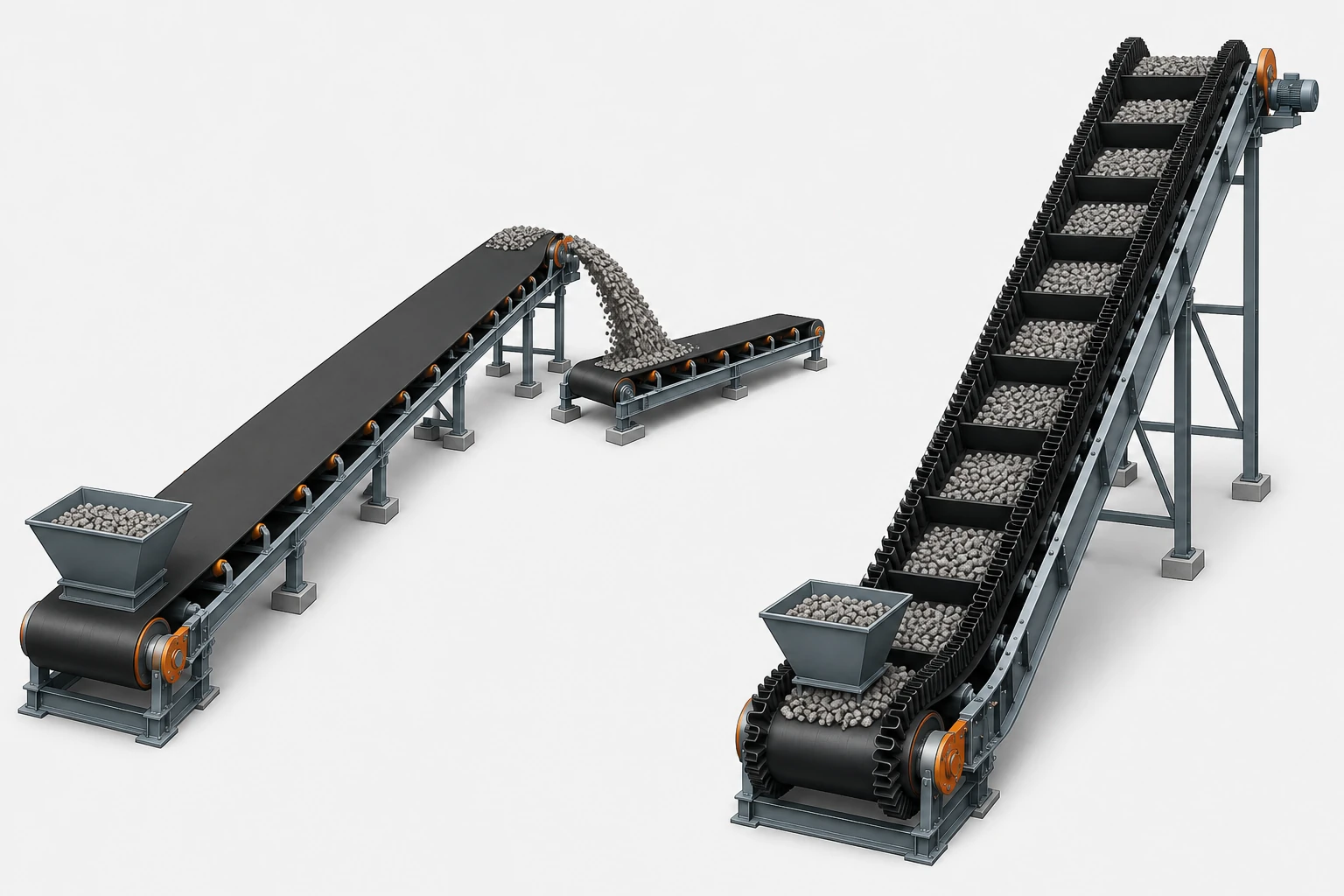
What Is the Main Difference?
The key difference is material control. A flat belt provides a simple carrying surface. A sidewall belt adds raised corrugated edges and cross cleats that form material-carrying pockets.
Flat conveyor belt
A flat belt has no belt-mounted corrugated sidewalls or transverse cleats. It is often suitable for horizontal or moderate-incline routes where material remains stable.
- Simpler construction
- Smoother carrying surface
- Usually easier to inspect and clean
Corrugated sidewall conveyor belt
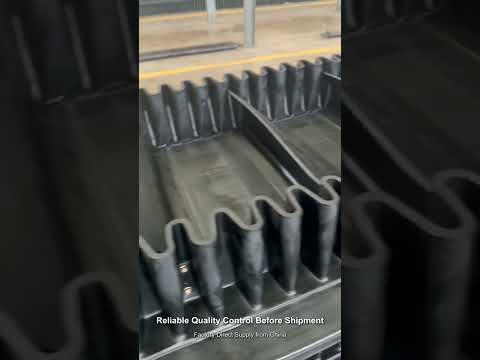
A sidewall belt combines a base belt, corrugated rubber sidewalls, and transverse cleats. These parts work together on steep or compact routes.
- Sidewalls provide edge containment
- Cleats support material on the incline
- Construction requires coordinated selection
Sidewall Conveyor Belt vs Flat Belt Comparison
A sidewall belt solves specific layout and material-control problems. A flat belt remains practical when those problems do not exist.
| Application factor | Flat belt | Corrugated sidewall belt |
|---|---|---|
| Horizontal conveying | Usually preferred | Usually unnecessary |
| Moderate incline | Often suitable if material remains stable | May be considered |
| Steep incline | Limited by material behavior and conveyor design | Better suited when correctly configured |
| Limited floor space | May require a longer route | May reduce horizontal footprint |
| Material rollback | Risk can increase with incline | Suitable cleats help support material |
| Lateral material loss | Depends on troughing, skirts, and loading | Sidewalls improve edge containment |
| Transfer points | May require several conveyor stages | May reduce transfers in some layouts |
| Inspection | Usually simpler | Includes the base belt, sidewalls, cleats, and bonds |
| Initial belt cost | Often lower for a simple construction | Often higher because of added components and customization |
The relevant comparison is total system cost, not belt price alone. Compare the complete route, transfer equipment, structure, installation, and maintenance access.
Steep Inclines: Where Sidewall Belts Have the Clearest Advantage
Consider a sidewall belt when material will not remain stable on a conventional belt. As the incline increases, particles may slide or roll toward the loading point.
Cross cleats divide the carrying area into pockets and support material as the belt moves upward. Corrugated sidewalls close the pocket edges and reduce lateral loss.
Material inputs
- Flow behavior
- Particle or lump size
- Moisture and surface condition
- Bulk density
Conveyor inputs
- Loading method
- Belt speed
- Cleat profile and spacing
- Complete conveyor geometry
There is no universal maximum angle for every sidewall belt. The allowable angle depends on the material, pocket configuration, loading, and complete conveyor design.
For detailed specification guidance, read the corrugated sidewall conveyor belt selection guide.
Limited Floor Space: A More Compact Conveyor Route
A steeper conveyor may reduce the horizontal space needed for a given lift height. This can help when buildings, equipment, roads, or structures limit the route.
A compact route may reduce
- Horizontal conveyor length
- Intermediate conveyors
- Transfer towers or chutes
- Total route footprint
The project must still review
- Pulley arrangement
- Support structure
- Return-side design
- Loading, discharge, and access
A shorter layout does not automatically reduce total project cost. Compare complete conveyor layouts before comparing belt prices.
Rollback and Side Loss: What Sidewalls and Cleats Actually Control
Sidewalls and cleats perform different jobs. Sidewalls contain material across the belt width. Cross cleats support material against rollback on the incline.
Neither component corrects poor feeding by itself. Material can still escape if the feed is off-center or the pockets are overloaded.
| Observed problem | Component or design area to review |
|---|---|
| Material moves toward the belt edges | Sidewalls, feed position, loading control, and usable carrying width |
| Material slides backward | Cleat profile, height, spacing, pocket shape, and incline |
| Material falls from the loading zone | Feed direction, drop height, impact control, and belt speed |
| Pockets overfill | Capacity, feed rate, belt speed, and loading control |
Transfer Points: When a Sidewall Route Can Simplify the System
A sidewall conveyor may combine parts of a horizontal and incline route. This can reduce the number of transfers between separate conveyors.
A compact sidewall route may use one continuous belt for part of the same path. Depending on the layout, this may reduce material drops, chutes, and points that need cleaning.
Not every sidewall system eliminates transfer points. Review transitions, loading, discharge, return arrangements, and maintenance access before selecting the route.
When Is a Flat Belt the Better Choice?
A flat belt is usually better when the conveyor is simple and the material remains stable. Avoid adding sidewalls and cleats unless they solve a clear problem.
Application reasons
- Conveying is mostly horizontal
- The incline is low
- Material does not roll backward
- The route has enough floor space
- Existing containment works well
System constraints
- Pulleys cannot accept the selected sidewall construction
- Return supports would contact the profiles
- Maintenance access is limited
- Cleaning requires a smooth surface
- Raised profiles provide no practical value
Confirm pulleys, support points, transitions, clearances, and cleaning methods before ordering either belt type.
What Should Buyers Compare Before Choosing?
Start with the conveyor route and conveyed material. Then compare the belt construction needed for each possible layout.
Conveyor data
- Inclination angle and lift height
- Horizontal length and complete layout
- Required capacity and belt speed
- Pulley diameters
- Loading and discharge positions
- Maintenance access
Material data
- Material name and bulk density
- Particle and maximum lump size
- Moisture and temperature
- Abrasiveness and flow behavior
- Tendency to roll, slide, or stick
Proposed belt configuration
- Belt width and length
- Base-belt construction and required strength
- Sidewall and cleat profiles
- Cleat spacing and effective carrying width
- Cross-rigid reinforcement, if required
- Splice method and finished belt form
Do not select these values separately. The route, material, capacity, pulleys, and belt construction must work as one system.
Use the sidewall conveyor belt quote-dimensions guide when recording an existing belt. Review available configurations on the corrugated sidewall conveyor belt product page.
Application Example: Limited Space and One Additional Transfer
A plant needs to lift bulk material 12 meters within limited floor space. A flat conveyor route would be longer and require one additional transfer point.
A sidewall configuration may be considered because it combines steep conveying with edge containment. Final design still depends on material behavior, capacity, pulleys, loading, discharge, and access.
Use the visual comparison near the top of this article as a concept guide. The final route still requires project-specific conveyor and material data.
Quick Decision Table
| If your application has… | Consider… | Confirm before deciding |
|---|---|---|
| Mostly horizontal conveying | Flat belt | Material stability, troughing, and containment |
| Low or moderate incline with stable material | Flat belt | Rollback at the planned speed and feed rate |
| Steep incline | Sidewall belt | Material, pockets, loading, pulleys, and discharge |
| Limited floor space | Sidewall belt | Route, structure, access, and total system cost |
| Material rollback | Sidewall belt with suitable cleats | Cleat profile, spacing, and material behavior |
| High lateral-loss risk | Sidewall belt or improved containment | Feed position and usable carrying width |
| Need to reduce transfer points | Sidewall system may help | Route geometry, loading, and discharge |
| Simple, low-cost conveyor | Flat belt | Whether raised profiles provide any value |
Sidewall Conveyor Belt vs Flat Belt FAQs
Is a sidewall conveyor belt better than a flat belt?
No. A sidewall belt is better for certain steep or space-limited applications. A flat belt is often better for simple horizontal conveying.
How steep can a sidewall conveyor belt run?
The practical angle depends on the material, cleat design, sidewall height, loading method, and conveyor geometry. Do not use one universal angle without engineering confirmation.
Are sidewall belts more expensive than flat belts?
Sidewall belts often have a higher initial cost because they use more components and customization. Compare total system cost, including transfers, structure, installation, and maintenance.
Can a sidewall conveyor reduce transfer points?
A sidewall route may combine horizontal and steep conveying within one system. This can reduce transfer points, but the result depends on loading, transitions, discharge, and layout.
Not Sure Whether You Need a Sidewall or Flat Belt?
Send Hongkun the conveyor angle, lift height, material data, capacity, belt width, and available layout drawing. If either belt type could work, compare both layouts before finalizing the specification.
