
How to Choose a Corrugated Sidewall Conveyor Belt: 6 Key Selection Factors
Choose the belt as a complete conveying system. Compare the conveying angle, material behavior, sidewall height, cleat design, base-belt strength, and pulley layout before confirming the specification.
Short answer: select a corrugated sidewall conveyor belt from the full application, not from belt width alone. The material, required capacity, incline, pocket dimensions, base-belt construction, and pulley arrangement must work together.
The six factors below turn the selection process into a practical specification for new conveyors and replacement belts.
Conveying angle
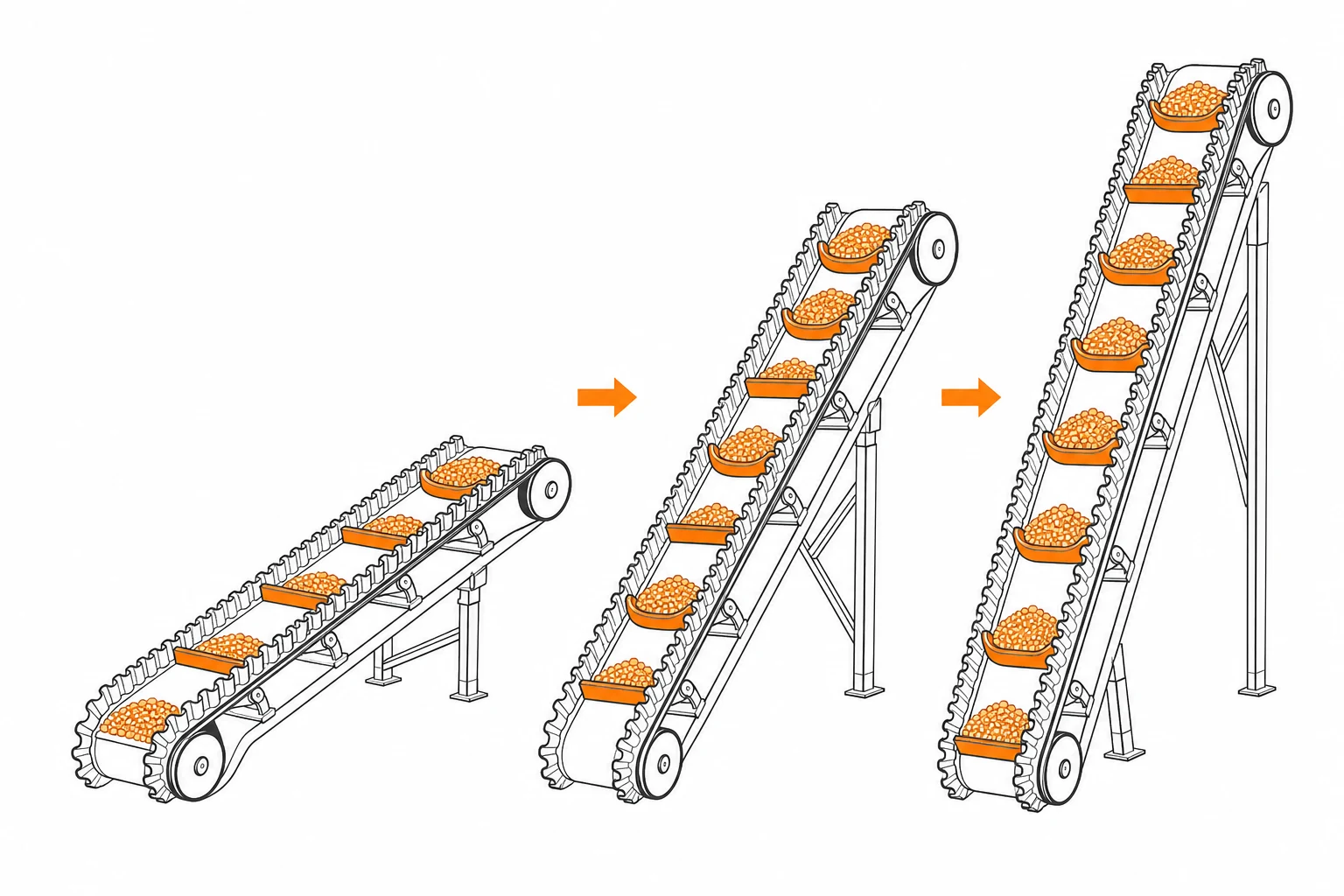
| Application condition | Cleat profiles commonly considered | What must be confirmed |
|---|---|---|
| Moderate incline | T-cleat or TS-cleat may be considered. | Material roll-back, particle size, capacity, loading, and belt speed. |
| Steep incline | C-cleat, TC-cleat, or TCS-cleat may be considered. | Pocket retention, sidewall profile, cleat reinforcement, pitch, loading method, and steep-angle sidewall conveyor applications. |
| Near-vertical or vertical | Scoop-style or reinforced cleat arrangements require project review. | Complete conveyor layout, material behavior, pocket capacity, pulleys, return run, and discharge. |
This is a selection guide, not a fixed angle-to-cleat rule. The same angle may require a different profile when the material, capacity, or loading arrangement changes.
Material size and flowability
Material behavior determines how easily the load stays inside each pocket. Fine powder, free-flowing grain, wet material, sticky product, and large lumps do not use the pocket in the same way.
Particle size
Provide the normal size range and the largest expected lump. Large pieces need enough pocket opening and discharge clearance.
Bulk density
Bulk density links pocket volume to mass capacity. It also affects belt load and cleat demand.
Flowability
Report moisture, stickiness, rolling tendency, compaction, and buildup. These factors affect loading, retention, discharge, and cleaning.
| Material input | Why it matters | Selection effect |
|---|---|---|
| Particle size | Controls pocket opening, loading, and discharge. | Influences cleat shape, pitch, sidewall height, and carrying width. |
| Bulk density | Converts volume into belt load and mass capacity. | Influences pocket volume, belt strength, and operating speed. |
| Moisture and flow | Affects sticking, rollback, buildup, and release. | Influences pocket shape, loading method, discharge, and cleaning. |
| Temperature or exposure | Affects the required rubber compound. | Must be matched across the base belt, sidewalls, cleats, and splice materials. |
Sidewall height
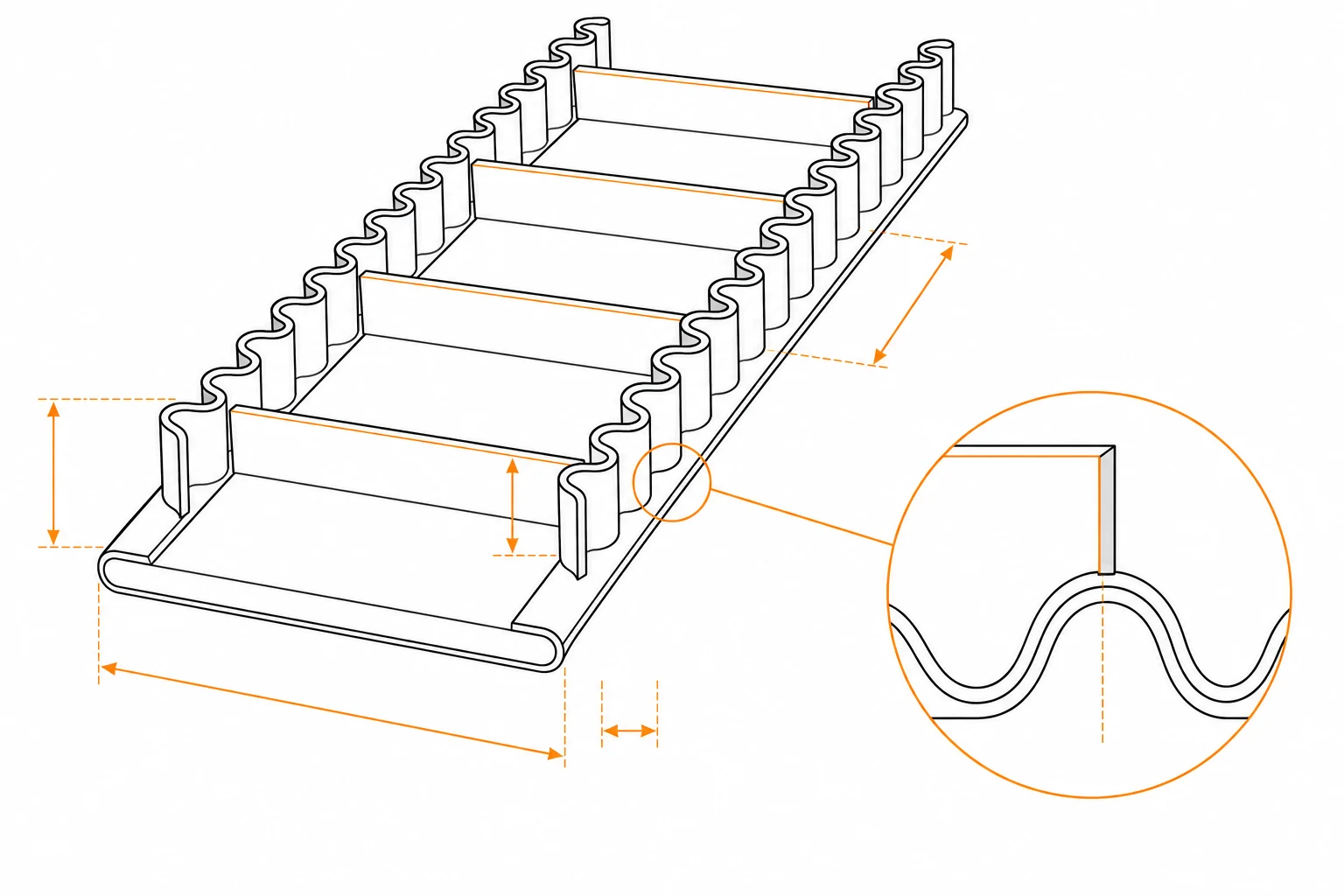
| Selection input | Why it affects sidewall height | What to confirm |
|---|---|---|
| Required capacity | Higher pocket volume may need more height, width, speed, or a different pitch. | Normal and peak throughput with operating units. |
| Particle size | The largest lumps must enter, travel, and discharge without interference. | Normal size range and maximum lump size. |
| Effective carrying width | Sidewall base width and free edges reduce the usable pocket width. | Total width, sidewall position, sidewall base width, and free edge. |
| Pulley arrangement | Taller profiles undergo more flexing around pulleys and deflection points. | Pulley diameters, transition geometry, return support, and clearances. |
View Hongkun’s coordinated base belt, corrugated sidewall, and cleat selection matrix on the product page. Final dimensions should be confirmed on an approved technical drawing.
Cleat type and spacing
Cleats form the pockets that carry the material. Their shape, height, pitch, stiffness, and connection to the sidewalls must match the incline, material behavior, loading method, and required capacity.
| Cleat decision | What it affects | What to review |
|---|---|---|
| Profile | Material support and retention as the incline increases. | T, TS, C, TC, or TCS options based on the complete application. |
| Height | Usable pocket depth and clearance within the sidewalls. | Sidewall height, particle size, filling level, and discharge. |
| Pitch | Number of pockets, pocket volume, and loading frequency. | Capacity, belt speed, material flow, corrugation spacing, and cleat alignment. |
| Connection | Pocket closure and flexing at pulleys or deflection points. | Cleat-to-sidewall gap, contact, vulcanized connection, or mechanical fastening. |
Drawing check: define the cleat-to-sidewall clearance or connection method. An unclear interface can create gaps, material leakage, or interference during belt flexing.
Base-belt strength and transverse rigidity
The base belt must carry the working tension, support the sidewalls and cleats, remain stable across its width, and still flex around the selected pulleys.
Longitudinal strength
Review working tension, lift, conveyor length, load, safety factor, elongation, take-up range, and splice method.
Transverse rigidity
The belt must resist sagging across its width while supporting the sidewalls and cleats on the carrying and return runs.
Cover compound
Match abrasion, heat, oil, chemical, weathering, flame, or antistatic needs to the actual service conditions.
Pulley diameter and system layout
The belt, sidewalls, and cleats flex through the complete conveyor path. Head and tail pulleys are only part of the review. Deflection wheels, transitions, return support, cleaners, loading, and discharge points also affect the selected belt.
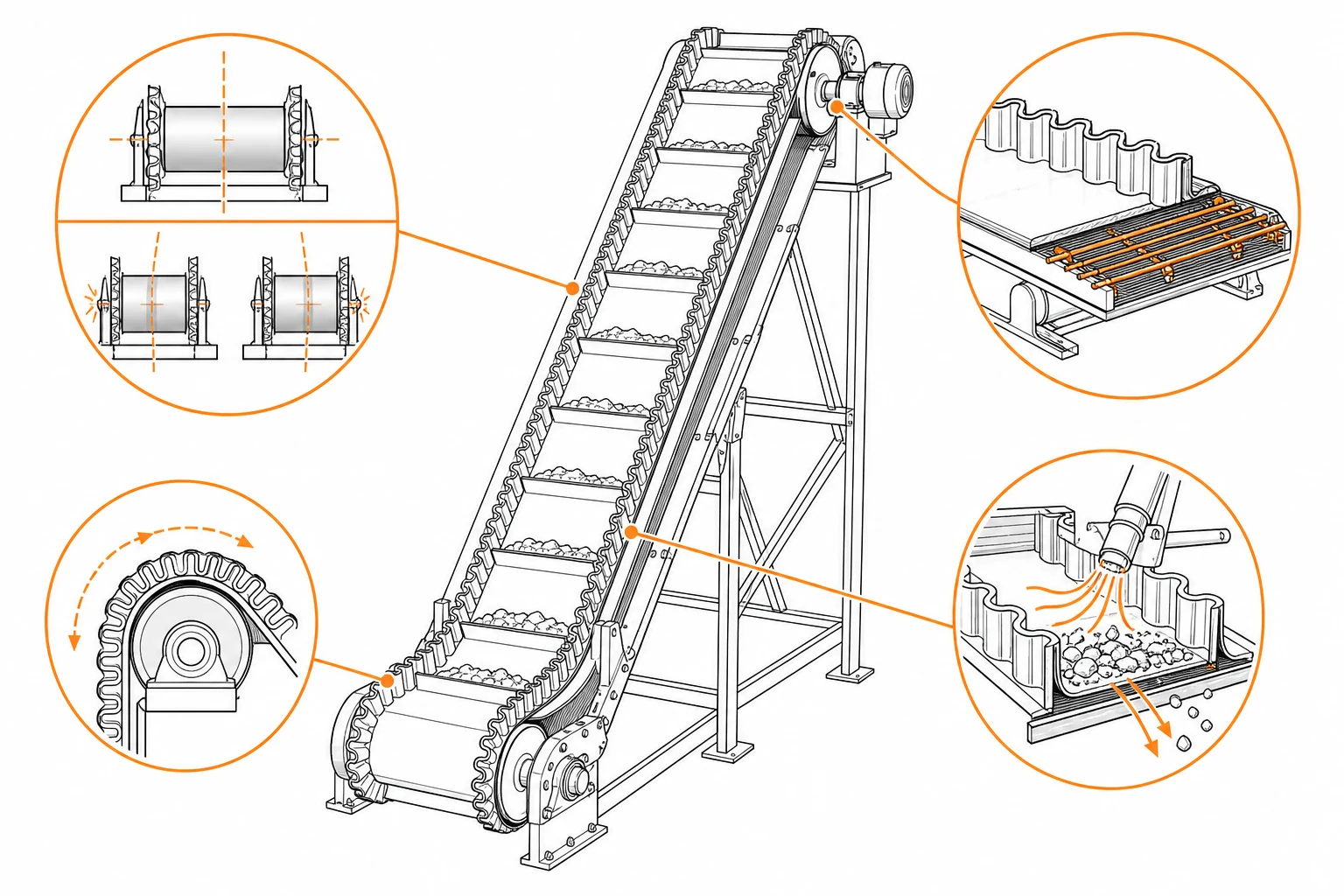
Confirm every pulley and deflection diameter. The selected sidewall profile, cleat arrangement, base belt, and splice must flex through the actual conveyor path.
Review transitions and return support. Stub rollers, support wheels, and frames must contact only approved areas and must not crush or rub the profiles.
Check loading and discharge. Center the feed, control impact, and provide enough clearance for the material to enter and leave each pocket.
Choose compatible cleaning. Avoid direct rigid-scraper contact with corrugated sidewalls and transverse cleats.
Corrugated sidewall conveyor belt selection FAQs
Can a corrugated sidewall belt convey material vertically at 90°?
Vertical configurations are possible for suitable materials and conveyor layouts, but 90° is not a universal rating for every belt. Review the material, cleat profile, pocket geometry, loading, discharge, capacity, pulleys, and return run together.
How is sidewall belt pocket capacity calculated?
Capacity depends on effective pocket area, cleat spacing, belt speed, bulk density, fill level, incline, and loading efficiency. A reliable calculation requires project inputs. Belt width alone is not enough.
How do I choose the correct sidewall height?
Match sidewall height to the required pocket volume, material size, effective carrying width, cleat height, pulley geometry, and available conveyor clearances. Confirm the final dimensions on a drawing.
Which cleat type should I use?
The choice between T, TS, C, TC, TCS, or another arrangement depends on the incline, material behavior, loading method, pocket design, and required capacity. Do not select the profile from angle alone.
What should I check before buying a corrugated sidewall conveyor belt?
Before buying, check the material, required capacity, conveyor incline, sidewall height, cleat type and spacing, belt width, pulley layout, rubber compound, and approved drawing. This sequence helps buyers understand how to buy sidewall conveyor belt products as one complete conveying system.
Can Hongkun select a replacement belt from a drawing or sample?
Yes. Hongkun can review confirmed dimensions, drawings, equipment information, photos, specifications, or an existing sample. Final dimensions and construction are agreed before production.
Confirm all six factors as one belt specification
Do not finalize the belt from one number, such as width, angle, or sidewall height. The selected design must combine the angle, material behavior, sidewall height, cleat arrangement, base-belt construction, and complete pulley layout.
Record the final dimensions and construction on an approved drawing. This gives the manufacturer, conveyor engineer, and buyer the same reference before production.
Send the application information you already have
Share the material data, capacity, incline, conveyor layout, pulley diameters, belt dimensions, drawing, or replacement photos. Hongkun can review the six selection factors and identify the details still needed before production.
