
EP Conveyor Belts
Hongkun supplies EP conveyor belts with polyester warp and polyamide weft reinforcement for bulk material handling. These polyester conveyor belts combine low longitudinal elongation with crosswise flexibility for troughed conveyors.
Specify the belt rating, ply count, dimensions, and rubber covers for your conveyor. Send an existing belt marking or drawing to request a replacement quotation.
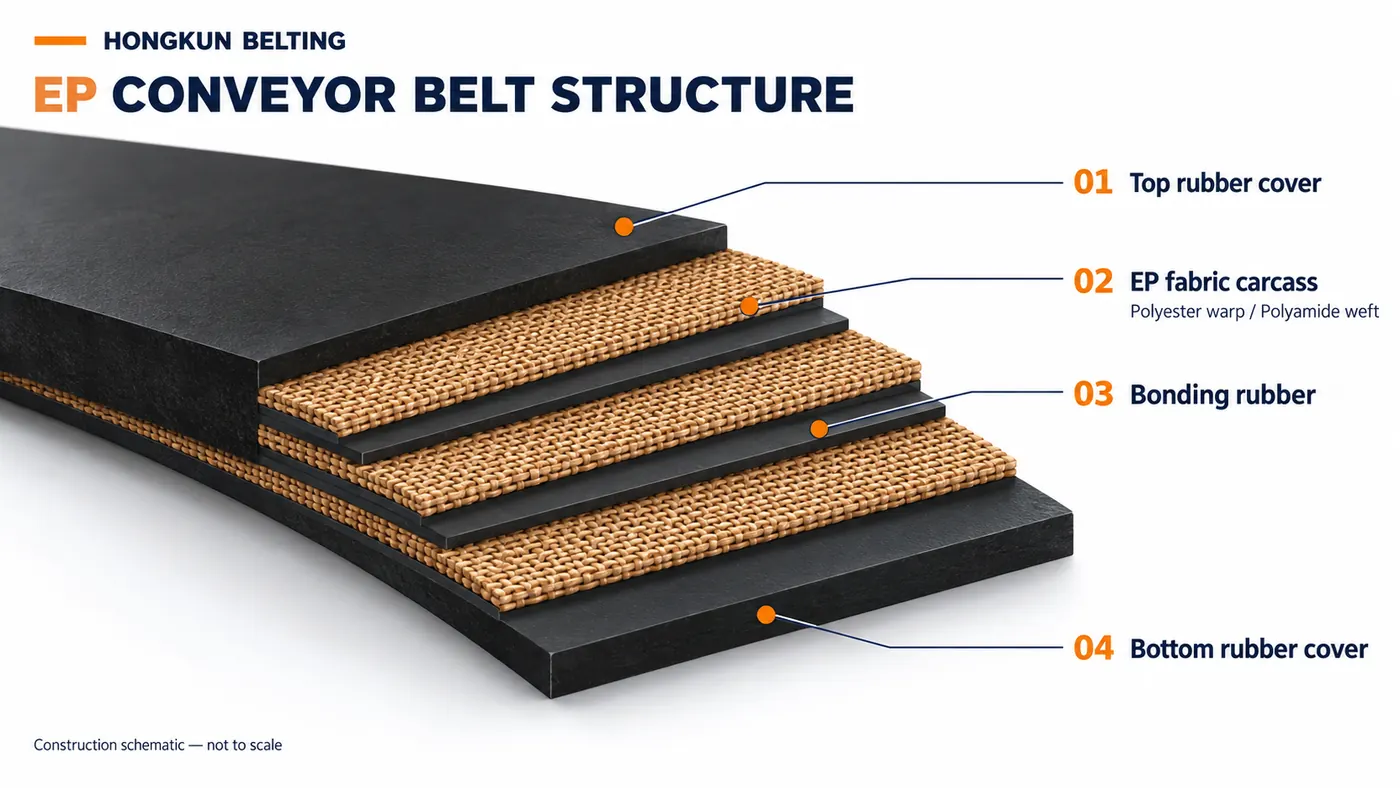
- EP carcass
- Polyester warp / polyamide weft
- Strength & construction
- Nominal strength in N/mm and fabric ply count
- Dimensions
- Width, total thickness, and required length
- Rubber covers
- Cover grade and top/bottom thicknesses
- Order-specific options
- Edge type, supply form, splice, and operating exposure
EP Specification Table
The fabric-series code identifies the individual EP fabric rating. The table shows nominal belt strength for each ply count. For example, the EP200 four-ply construction corresponds to 800 N/mm.
EP Fabric Series and Nominal Belt Strength
Swipe to view the full table →
| Fabric series | 2 plies (N/mm) | 3 plies (N/mm) | 4 plies (N/mm) | 5 plies (N/mm) | 6 plies (N/mm) |
|---|---|---|---|---|---|
| EP100 | 200 | 300 | 400 | 500 | 600 |
| EP125 | 250 | 375 | 500 | 625 | 750 |
| EP150 | 300 | 450 | 600 | 750 | 900 |
| EP200 | 400 | 600 | 800 | 1000 | 1200 |
| EP250 | 500 | 750 | 1000 | 1250 | 1500 |
| EP300 | 600 | 900 | 1200 | 1500 | 1800 |
| EP350 | 700 | 1050 | 1400 | 1750 | 2100 |
| EP400 | 800 | 1200 | 1600 | 2000 | 2400 |
| EP500 | 1000 | 1500 | 2000 | 2500 | 3000 |
| EP630 | 1260 | 1890 | 2520 | 3150 | 3780 |
Nominal belt strength is not allowable working tension. Conveyor calculations and splice design determine the operating requirement. The order specification states the finished-belt acceptance requirements.
Rubber Cover Thickness Reference
Swipe to view the full table →
| Fabric series | Top cover (mm) | Bottom cover (mm) |
|---|---|---|
| EP100, EP125, EP150, EP200, EP250 | 1.5–30 | 1.5–20 |
| EP300, EP350, EP400, EP500, EP630 | 2–30 | 2–20 |
Cover thickness is selected with the carcass, material, and pulley geometry. Width, roll length, and total thickness are specified for the selected construction.
Construction & Features
An EP rubber conveyor belt uses woven polyester/polyamide fabric to carry tension. Rubber covers protect the material side and pulley side. Bonding rubber joins the fabric plies.
- Polyester warp: Runs along the belt and supports low longitudinal elongation. Working tension and take-up travel remain part of the design.
- Polyamide weft: Runs across the belt and provides crosswise flexibility for troughing.
- Rubber covers: Match the material contact, abrasion, and operating exposure.
- Bonding layers: Join the plies; adhesion requirements belong in the finished-belt specification.
Belt width, carcass thickness, and idler geometry affect troughability. A higher ply count can also change bending behavior and pulley requirements.
For EP, NN, and CC comparisons, visit Fabric Conveyor Belts.
How to Read EP Specifications
Order marking example: 1000 mm / EP800/4 / 4+2 mm
| Field | Meaning |
|---|---|
| 1000 mm | Belt width |
| EP800/4 | EP carcass, 800 N/mm nominal belt strength, four fabric plies |
| 4+2 mm | 4 mm top cover and 2 mm bottom cover |
This construction matches the EP200 four-ply row above. EP200 names the fabric series; EP800/4 expresses the nominal finished-belt strength and ply count.
Add the cover grade, total thickness, length, edge type, and supply form to complete the order. Total thickness includes the carcass and bonding layers as well as both covers.
Rubber Cover Options
EP describes the reinforcement material. The rubber compound determines the cover properties needed for abrasion, heat, oil, or chemical exposure.
H, D, and L Cover Property Reference
Swipe to view the full table →
| Cover designation | Tensile strength (MPa) | Elongation at break (%) | Abrasion volume loss (mm³) |
|---|---|---|---|
| H | 24 | 450 | 120 |
| D | 18 | 400 | 100 |
| L | 15 | 350 | 200 |
Test methods: ISO 37 for tensile properties and ISO 4649 for abrasion. The purchase specification defines test conditions and acceptance limits.
D has the lowest abrasion volume-loss value in this table under comparable test conditions. H has the highest tensile strength and elongation values. These results describe different properties; abrasion testing alone does not establish cut or impact resistance.
State the required cover designation and product standard together. H/D/L should not be substituted for DIN W/X/Y/Z solely by matching a letter or one property.
For hot material, see Heat Resistant Conveyor Belts. Include normal and peak material temperatures, belt-surface temperature when available, and contact time.
For oil or chemical contact, provide the substance, concentration, temperature, and exposure duration. Fire or antistatic requirements need their own specification and supporting documents.
Industrial Applications
EP conveyor belts serve bulk-material conveyors where the carcass, covers, and conveyor geometry suit the duty.
| Bulk-material duty | Main specification inputs |
|---|---|
| Ore, crushed stone, sand, and gravel | Belt tension, lump size, abrasion, and loading impact |
| Limestone and cement raw materials | Transfer conditions, dust, wear, and material temperature |
| Port and stockyard bulk transfers | Cargo type, throughput, moisture, and take-up travel |
| Surface coal and power-plant handling | Coal size, loading conditions, and required fire/antistatic performance |
| Steel-plant raw materials | Sharp particles, loading impact, and actual thermal exposure |
| Bulk fertilizer and salt | Material composition, moisture, caking, and chemical contact |
Fire, antistatic, heat-resistant, and chemical-resistant properties are specified separately from the EP carcass.
For steep inclines requiring material retention, see Corrugated Sidewall Conveyor Belts.
Quotation Checklist
For an existing EP belt, start with the complete marking and basic dimensions. Add conveyor data when changing the construction or investigating early failure.
| Item | Details to send |
|---|---|
| Belt dimensions | Width, total thickness, and length; identify open or endless length |
| EP construction | Nominal belt strength, ply count, and old marking or drawing |
| Rubber covers | Top/bottom thicknesses, cover grade, and material exposure |
| Conveyor | Working tension, speed, pulley diameters, trough angle, and take-up travel |
| Material | Name, particle size, bulk density, capacity, and loading height |
| Order requirements | Quantity, destination, edge type, supply form, and splice requirements |
| Acceptance requirements | Applicable standard and edition, tolerances, test scope, and required documents |
Include damage photos if wear, stretching, edge cracking, or delamination has shortened service life.
EP Conveyor Belt FAQs
1. Is EP200/4 the same as EP800/4?
Only when EP200 identifies a 200 N/mm individual fabric rating and /4 means four plies. Under that convention, 200 × 4 gives 800 N/mm, matching the EP200 row in our table. EP800/4 states the nominal finished-belt strength directly. Some suppliers use EP200/4 to mean a 200 N/mm finished belt with four plies. Write the finished-belt strength and ply count as separate fields in the order.
2. Can I replace a three-ply EP belt with four plies?
Possibly, but width alone does not establish interchangeability. The replacement must suit the required belt strength, total thickness, pulley diameters, and trough geometry. More plies can change bending flexibility and splice requirements. Send both constructions and the conveyor data before changing the belt.
3. How much will an EP conveyor belt stretch in service?
The EP designation alone does not define a working-elongation percentage. Elongation depends on construction, load, and operating history. For a specified limit, state the test method and reference load. For an existing stretching problem, include working tension, available take-up travel, and splice movement.
4. What minimum pulley diameter does an EP belt need?
There is no single diameter for all EP constructions. Belt rating, carcass thickness, operating tension, and splice design affect the requirement. Send the drive, tail, snub, and take-up pulley diameters, plus belt width and trough angle. Use the requirements for the selected construction when checking the conveyor layout.
5. Can I specify different covers on an EP belt?
Specify the cover grade and top/bottom thicknesses separately from the EP rating. For abrasive material, include particle size and loading conditions. For heat, oil, or chemical exposure, include temperature and contact details. The quotation should identify the proposed compound, complete construction, and applicable acceptance requirements.
6. What if my old EP belt marking is unreadable?
Send the width, length, total thickness, and photos of the belt surface and cut edge. Include any drawing, previous purchase specification, or test report. Conveyor tension, pulley sizes, and material data help identify the required construction. State quantity and destination for the quotation.
Request an EP Conveyor Belt Quote
Send your belt marking or drawing, dimensions, quantity, and operating details. Identify whether you need the existing construction replaced or a change for a specific service problem.
